

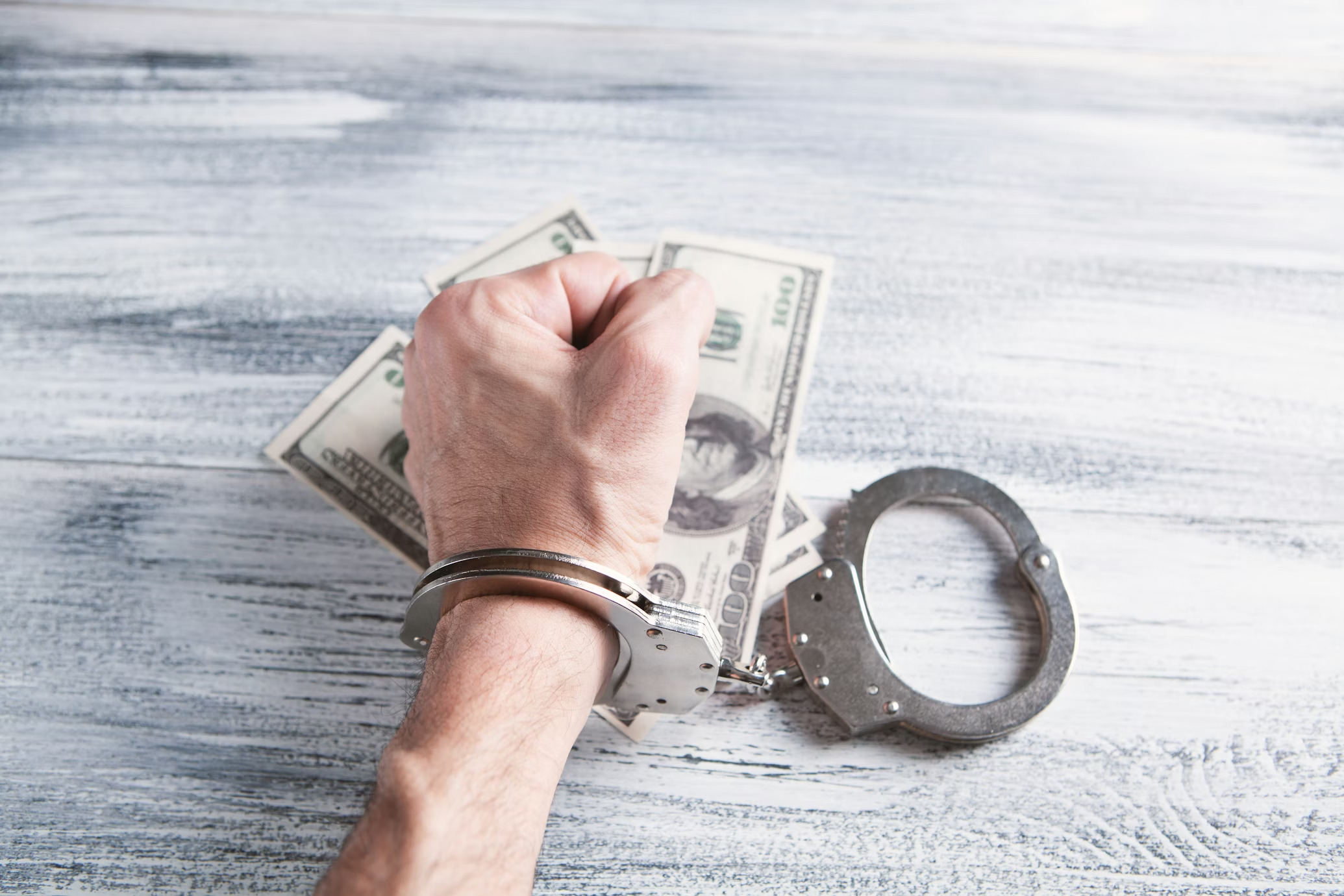
Across the countless news headlines and movie scenes capturing the intrigue of criminal indictment, one can almost always find a mention of cash bail. These real and fictional scenes often surround questions of who will “put up” one’s bail, whether one can afford bail, and whether the accused deserves the opportunity to “go out on bail” at all. But these headlines never answer a more fundamental question: What does cash bail really set out to accomplish, and why do we take it for granted as a pillar of our justice system?
Despite the renown of cash bail, its implications for real-world individuals navigating the justice system have escaped the spotlight of public discourse. While the system of cash bail may be designed with good intentions, it is, in reality, little more than a “pay to play” scheme that allows individuals to trade money for freedom as they await their trial and verdict. Every day, thousands of legally innocent people — as they have not yet been proven guilty — remain in jail cells, not because they have been convicted of a crime, but because they cannot afford to buy their freedom.
Before evaluating the effectiveness and fairness of cash bail, it is important to understand what this longstanding aspect of our justice system really is. Cash bail is a financial condition imposed upon individuals who have been arrested but not yet tried, acting essentially as a deposit to prove that the individual will show up for court. If an individual has enough funds to pay the amount set by the court, then they are released until trial. However, if they are unable to foot the bill, they remain incarcerated for a period ranging from days to months. The judge determines the amount of bail by carefully considering factors such as the severity of the alleged crime, prior criminal history, and risk of flight. However, in practice, bail schedules and judicial discretion can lead to inconsistencies or disproportionately high bail amounts for low-income defendants.
The system of cash bail was originally established for a simple reason: to ensure that those accused of crimes would reliably appear in court for their trials. But how the system has arrived at what it is today is an entirely different story. In 1789, Congress introduced the practice of setting cash bail via the Judiciary Act, guaranteeing the right of defendants to have bail in non-capital cases. At the time, this system was built to promote the consistency of pretrial releases. This meant that defendants charged with the same offenses would be given comparable bail, rather than a judge’s discretion being the sole deciding factor.
But in the twentieth century, the rise of commercial bail and for-profit bail bond companies transformed this feature of the justice system into a lucrative industry shaped by entrenched political power. A bail bond serves as a resource for defendants when they cannot afford to pay bail. Essentially, the company will pay the amount of the bond on the defendant’s behalf, and in return will take a portion of the bail’s value as compensation for the service of providing the capital. Today, the bail bond industry has an annual revenue of over $2 billion and spends millions lobbying against reforms that could threaten its business model. In many states across the country, bail bond agents typically charge non-refundable fees of up to 10% of the posted bail amount. These agents directly monetize the desperation of the accused — especially those from low-income backgrounds — and families who are attempting to free loved ones.
The consequences of the monetized bail market are deeply concerning. According to data from the Prison Policy Initiative, 400,000 individuals across the United States are held in pretrial detention, with approximately half remaining in detention because they are unable to afford bail. A large portion of those held on bail, who have not yet been convicted and are accused of low-level offenses, have a lack of wealth that literally strips them of freedom when it comes time to put up cash bail. Because of these defendants’ prolonged incarceration while awaiting trial, their housing, employment, and even custody of their children are all at risk. Many who are unable to pay for bail — or the still-high cost of a bail bond — settle for plea deals out of necessity. Such a coercive system undermines the cherished American legal principle of “innocent until proven guilty.”
To make matters worse, the injustice of often-unaffordable cash bail is compounded by the inconsistency of bail amounts. For the same or similar offense, Black and Latino defendants are often assigned a substantially higher bail than White defendants. Rather than assessing the flight risk or threat to public safety of an accused individual, many judges seem to project socioeconomic and racial biases onto bail decisions.
There has been gradual growth in awareness among lawmakers, prosecutors, and the public about the shortcomings of the cash bail system, but the problem persists, especially with the help of misinformation and political inertia. Proponents of cash bail, including many prosecutors and law enforcement officials, contend that eliminating cash bail would significantly endanger public safety. They argue that monetary bail ensures court appearances and deters crime before trial, and that any unequal impact on less wealthy defendants is an unavoidable necessity. In a world of sky-high bail costs, however, this argument is built on the flawed notion that a person’s risk level or likelihood of appearing in court can be assessed by their economic status and access to financial capital. It is clear that someone with access to money is not less dangerous than someone without. The only thing it does mean is that they can afford the price tag of their freedom. Furthermore, judges have the power to keep an individual in jail if they believe them to be truly dangerous. In United States v. Salerno, the Supreme Court decided that courts are able to detain individuals if no release conditions could truly protect public safety.
In spite of these injustices of the cash bail system, the critic might still contend that there is no better way to ensure reliable court appearance with consistent standards. But even now, there are existing alternatives to cash bail that are effective without disproportionately affecting the poor. Pretrial services, for example, help ensure people will show up to court without forcing individuals to stay in jail. Services like court date reminders, check-ins, and electronic monitoring all contribute to increased court appearance rates.
Moreover, judges now have access to sophisticated risk assessment tools that aim to make pretrial decisions more objective. These tools are algorithms that can evaluate the likelihood that a defendant will fail to appear to court or reoffend. The most common tools are Public Safety Assessment (PSA) and Correctional Offender Management Profiling for Alternative Sanctions (COMPAS), though these are often criticized for having socioeconomic and racial biases embedded in the data that drives their systems. As Harvard Law Professor Crystal Yang asserts in “Equal Protection Under Algorithms: A New Statistical and Legal Framework,” predictive models can generate “proxy effects of race … that can lead to racial disparities that many view as unwarranted and discriminatory.” As with any aspect of the law, reformers must be careful not to create new unfair systems while trying to fix the previous one. Nonetheless, risk assessment tools, when used thoughtfully in trustworthy hands, offer a more reliable system than cash bail for determining when pretrial release is warranted.
In an encouraging development, a growing number of jurisdictions are showing that fairness and safety can simultaneously exist in the justice system. In 2017, New Jersey implemented a new policy decreasing the maximum price of cash bail for nonviolent offenses. The change led to a notable plummet in pretrial jail populations with no measurable increase in crimes or absences in court. In Washington, D.C, the majority of individuals are released before trial without having to pay bail. Eighty-eight percent of these individuals still show up in court, proving the plausibility of ensuring court appearance without monetary bail. In the most substantial shift yet, two years ago, Illinois became the first state to abolish cash bail. Because the law only took effect in 2023, comprehensive data on its long-term effects are still emerging, but this statewide implementation of reform signals a broader shift in the national conversation around cash bail.
In the face of statistical evidence against cash bail, critics are quick to point out the relatively rare, extreme cases of individuals escaping justice and committing crimes in the pretrial period as reasons to cling to the cash bail system despite its harm to millions of defendants. For example, following New York’s 2020 bail reform, media outlets widely reported the case of Tiffany Harris, a woman who was released without bail for a misdemeanor assault and was subsequently rearrested the following day for assaulting another woman. Critics used this instance retroactively to illustrate problems with the shift away from cash bail. While any decision giving way to more crime is a travesty, policies should not be based on these resolvable exceptions. In reality, the tools we need to keep communities safe and keep the justice system running efficiently — without criminalizing poverty — already exist. What we lack is political will.
Ultimately, the evidence makes clear that the cash bail system in practice criminalizes poverty and undermines the foundations of fairness and equality in our justice system. The fact that over 400,000 American citizens are stuck in pretrial detention because of the inability or impracticality of putting up their cash bail exemplifies the reduction of freedom to a price tag in the cash bail system. The markedly higher bail amounts set for Black and Latino defendants show how the system not only forces individuals into pretrial detention, but does so in a way that deepens inequality. And even more fundamentally, it is simply ironic that we live in a country where we treasure “innocent until proven guilty” yet perpetuate a system that pressures people to plead guilty just to escape detention. Defending the cash bail system means accepting that a person’s bank account says more about them than their individual qualities and circumstances, and even their guilt or innocence.
Opposing arguments that claim eliminating cash bail endangers public safety couldn’t be further from the truth. Judges are already able to detain the select individuals who do pose a continued threat to the public, and states have shown that alternative methods are effective. The successful policy shifts in Washington, D.C., New Jersey, and Illinois demonstrate that fairness and safety are not mutually exclusive objectives of our justice system.
True justice demands reform. As a society, we must move from wealth-based detention to evidence-based decisions. Ending cash bail is not just about the policy; it is about the principle. A more equitable justice system for all is attainable. We just need to recognize the need for it and gain the courage to build it.