

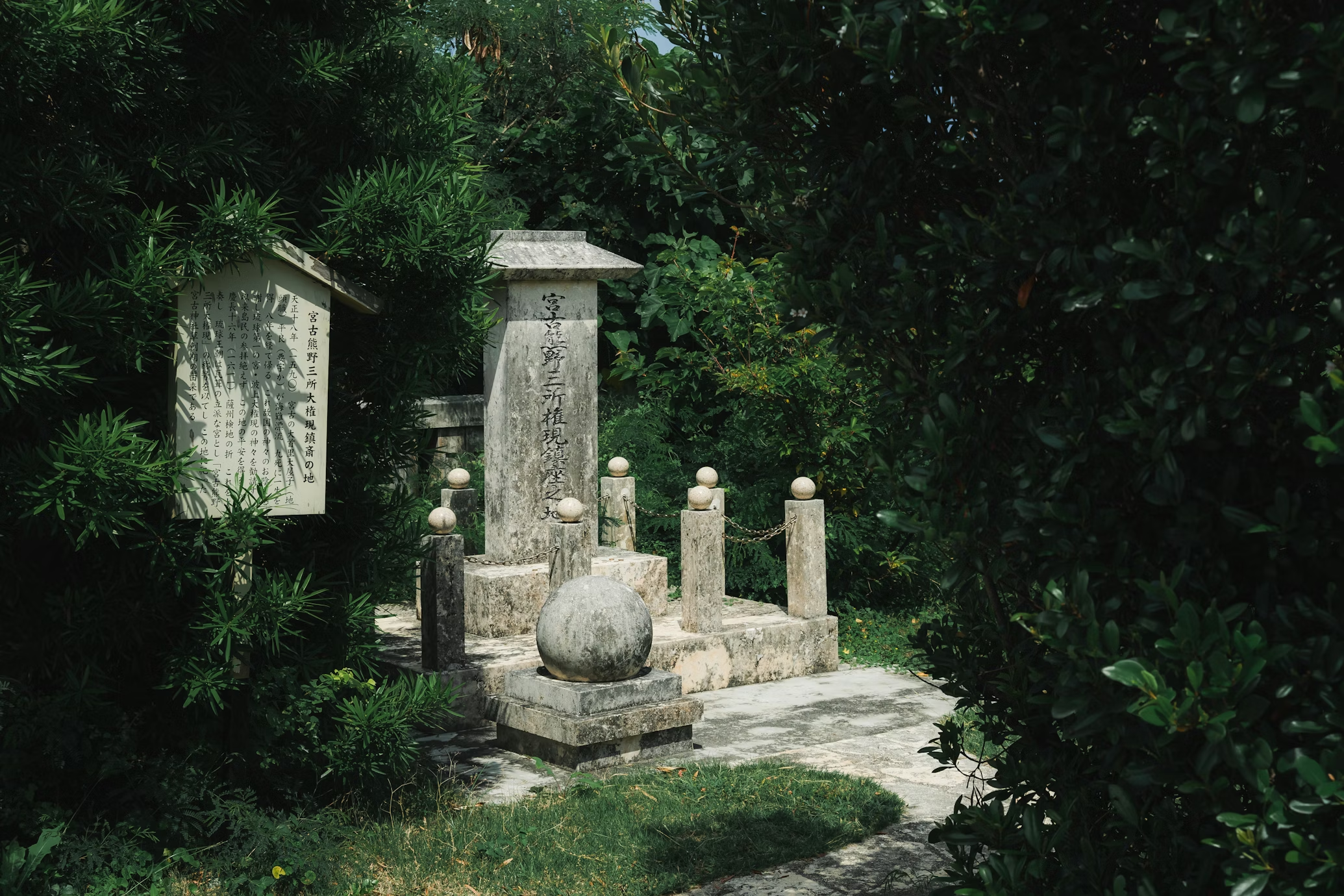
Each year on Qingming Festival, also known as All Soul’s Day, the same ritual unfolds: Chinese families make their way to their ancestral graves to pay their respects. Paper offerings are burnt, tombstones are wiped clean, and food offerings are laid out in quiet remembrance.
However, what happens when those graves are no longer there?
In China, “平坟复耕” (digging graves for farmland) campaigns have led to the largest grave relocation in human history, with more than 10 million corpses disinterred to raise agricultural productivity. A similar story played out in Singapore: Over 4,000 graves from Bukit Brown Cemetery — the largest Chinese cemetery outside China, and one of the very few left in Singapore — were exhumed to make way for Lornie Highway, a road that now cleanly bisects it. These exhumations are part of a broader trend in which the dead have increasingly made way for the living in the name of development.
These policies are often presented as necessary in the name of development, but grave exhumations are not solely a response to scarcity. Rather, they are a reflection of political will that reveal deeper concerns about what development is for, which values we prioritize, and who gets a say when hard choices are on the table. How we treat the dead, it turns out, tells us a great deal about the living.
The rationale behind large-scale grave exhumation is oft-repeated: Land is scarce, and tombs inefficiently use space.
As early as the Great Leap Forward in 1958 — Mao Zedong’s campaign to rapidly industrialize and collectivize China’s economy — slogans like “平坟开荒,向鬼要粮” (flatten graves and open up the land, ask the ghosts for grain) made it clear that the dead would be sacrificed in the quest for productivity. Tombs were leveled and destroyed, gravestones were used to build bridges and roads, coffins were used to build houses and sheds. Similarly, in Singapore, the Housing Development Board had exhumed a total of 21 cemeteries and 120,000 graves by the 1980s to support the country’s rapid economic expansion.
The modern revival of grave exhumation policies in China’s Henan and Anhui provinces recalls this history. In response to public criticism, Henan Provincial Chinese Communist Party Committee Secretary Lu Zhangong replied, “Given our responsibilities to the people and the future, what are we to do?” In the present day, during the exhumation of Bukit Brown, Singapore’s then-Minister of State for National Development Tan Chuan-Jin admitted wryly that “difficult decisions about land use have to be made, and sometimes, the development of places such as Bukit Brown is unavoidable.”
Closer scrutiny reveals how flimsy these justifications can be. In Zhoukou, a Henan city, more than two million graves were flattened to reclaim just 3,000 hectares of farmland, which amounts to only 0.2% of the city’s existing agricultural land. With a population of 5.5 million spread over just 719 square kilometers in Singapore, there is no question that land is limited. Yet, Singapore is home to 16 golf courses — one of the highest golf-course-to-land densities in the world — occupying a total of 1,397 hectares of land. By comparison, Bukit Brown spans a meagre 233 hectares.
The juxtaposition of these figures suggests that the true rationale underpinning grave exhumations is not merely space. Rather, we may find it easier to blithely trade off intangible cultural goods in the name of material development. Cemeteries, in particular, are among the lowest of low-hanging fruits in urban redevelopment. The dead are, quite literally, voiceless, and graveyards are viewed by many as eerie spaces best avoided — and unlike real estate developments or golf clubs, they lack powerful advocates.
Though some may believe that graves are simply parcels of unused land, they carry significant value. From an anthropological perspective, the invention of tombs and the ritual burial of ancestors, rather than abandoning their remains in the wilderness, was an important symbol of the transition from barbarism to civilization. Graveyards have since become a microcosm of the filial piety and historical tradition ingrained in Chinese culture, evinced by Confucian maxims like “Be circumspect in funerary services and continue sacrifices to ancestors, and the common people will thrive). Therefore, ancestral graves have a firm grasp on the imagination and history of Chinese families.
In Singapore, Bukit Brown embodies these values too. Established in 1922, it holds the remains of more than 100,000 individuals. Some tombkeepers bear oral histories from the Japanese Occupation; many tombstones mark the resting places of pioneers who built Singapore into a modern city. The cemetery represents a link to a storied past for the living, who benefit from the nation‐building project that Bukit Brown is at the heart of.
Even if one accepts that some development is unavoidable, the means by which grave exhumations are carried out often reflect a disregard for the dignity of the dead, and the living relatives tethered to them. In Zhoukou City, Henan province, locals report being given less than a day’s notice to relocate ancestral graves, with the threat of exorbitant fines or forceful demolishment in the case of non-compliance. In 2014, in Anhui province, several elders took their own lives days before a burial ban came into force, hoping to avoid cremation and keep their bodies intact, as in line with Chinese tradition.
Singapore’s exhumation process saw a concerted effort to preserve the heritage found in Bukit Brown, with the government allocating $250,000 for a yearlong documentation project. Nonetheless, Bukit Brown’s partial demolition was at times troubling in its opacity. The Singapore Heritage Society (SHS) was informed of the decision to build Lornie Highway through Bukit Brown just two weeks before the public announcement, with neither the time nor the intention to engage in serious debate over any alternatives. SHS contended that the primary purpose of the consultation, rather than providing a genuine platform for civil society, was “to manage public opinion and to tap on SHS’s network”.
Singapore is a mere dot on the world map; China, on the other hand, spans half of East Asia. Yet, China’s grave exhumations outstripped Singapore’s in violence and scale, suggesting that beyond need, political will shapes how the dead are treated. Models for change exist elsewhere: In Hong Kong, potential heritage sites are listed and opened to public consultation through the Antiquities Advisory Board, whose decisions and minutes are made public. In the United Kingdom, preservation decisions involve non-governmental organizations and community groups. These mechanisms do not guarantee that land scarcity can always be resolved, but they create space for civic discourse that can help us reach a better consensus on difficult trade-offs.
Qingming is meant to be a day of remembrance dedicated to the loved ones families have lost, but in places where graves have been levelled and names erased, there is little left to return to. The earth, once marked by incense and offerings, has been repopulated with more “useful” crops, roads, buildings: land use that is less about resource scarcity and more about active decisions to privilege the tangible over the intangible. In cases like these, it is worth interrogating what kind of progress we are truly pursuing, and whether we are willing to give in to the blunt force of expediency, or stand with those who cannot speak for themselves.