

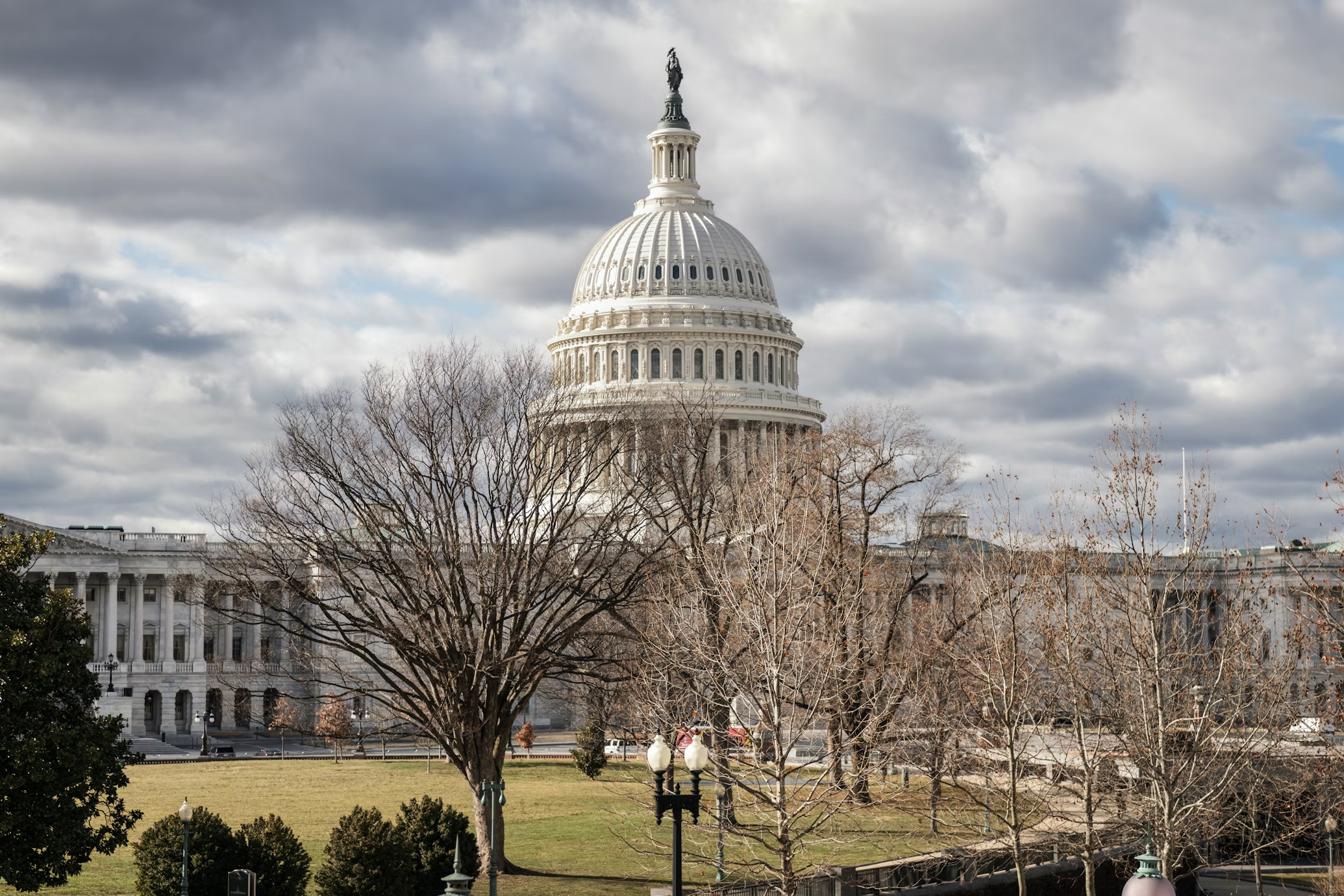
Like any well-designed legislature, the U.S. House of Representatives is designed to reflect who we — the people — are, what we prioritize, and how we seek to live. Since the nation’s founding, the House of Representatives has served as the branch of the federal government most directly tied to the will of the American people. James Madison stated in Federalist Paper No. 57, “Hence, in the fourth place, the House of Representatives is so constituted as to support in the members an habitual recollection of their dependence on the people.” The constitutional framers intended that the House would be, compared to the Senate, more dependent on and influenced by the people.
Originally, the House grew as the country grew, so that no one representative was responsible for the will of too many constituents. However, in 1920, Congress continually failed to pass a reapportionment bill based on the new census data. This was due to the mass migration of people from rural areas into the urban centers, matched with a Congress still controlled by representatives from rural areas who did not want to see their power in government diminish as a result of this demographic shift. Thus, the House failed to expand following the 1920 census. Nearly a decade later, Congress solidified the number of representatives at 435 with the Permanent Apportionment Act of 1929.
While that decision settled the argument over the urban-rural division of power for the moment, it has ultimately proven detrimental to the representation of Americans’ voices. In 1910, the United States population was around 92 million; today, that number has more than tripled. Additionally, in 1929, the 435 members of the House represented only 48 states, as Alaska and Hawaii had not yet gained statehood.
In the 1910 census, each member of the House represented about 210,000 people. Today, each member of the House represents an average of over 760,000 people. There is also a substantial deviation between states in the number of constituents per representative, due to a cutoff for when a state receives another seat in the House. This cutoff is dependent on the percentage of the country’s population the state holds. For example, Delaware, whose population was 989,948 in 2020, was just below the cutoff for a second representative. However, Montana, whose population was 1,084,225 in 2020, was just above the cutoff for a second representative. Therefore, Delaware’s single representative represents 989,948 people, whereas Montana’s two representatives represent about 542,000 people each. Many Americans rely on their members of Congress for information and access to entitlement programs, so when districts are more populous, it’s harder for a member of Congress to be able to fulfill every constituent’s needs. It is also more difficult for one individual to accurately represent the will of 700,000 people when working on Capitol Hill, putting voters in large districts at an even greater disadvantage.
This imbalance in representation has also affected the Electoral College, as the number of electors each state receives is equivalent to its number of elected representatives in the House and Senate. The framers intended for the influence of small and large states in the Electoral College to be balanced, as a fixed size in the Senate would ensure the small states wouldn’t lose their influence, and a growing House would give the more populous states a greater impact in electing the President that grows with their population. Capping the size of the House has undermined this goal, as residents of larger states are far less represented in the Electoral College than their small-state counterparts today. The most drastic difference is between Wyoming and California, where electors represent roughly 192,000 and 732,000 voters, respectively. Expanding the size of the House—and as a result the number of electors—would not completely eliminate this imbalance, but it would lessen it, as the number of people each elector represents would be more unified across the country.
Given these many challenges, it is imperative that we remove the cap on the number of representatives established by the Permanent Apportionment Act of 1929 and allow the House to grow with each census again. This would mitigate the uneven representation across states, make each House member more responsive as they represent a smaller number of people, and enable the presidential election system to more accurately represent the people’s will without any politically contentious change to the Electoral College itself. The road to expanding the House is rather straightforward, as Congress and the President can simply pass a bill overriding the Permanent Apportionment Act, thus modernizing the apportionment of representatives.
In addition to bolstering representation, adding more districts would restrict the influence of corporate and singular large donations to campaigns. If there are more districts, then they will be smaller, likely making campaigns cheaper due to the smaller scope of voters. Also, if there are more elections, it would be more challenging for any one group to be able to influence enough lower-cost elections to have a substantial effect on policy decisions.
Expanding the number of representatives could additionally have the effect of increasing diversity in the House. Currently, the House is about 72% White, 71% male, and has a median age of 57.9. Financial and incumbency barriers are some of the core systemic barriers that prevent women, young people, and non-White candidates from winning a seat. With smaller districts less vulnerable to corporate campaign contributions and open seats unblocked by incumbency advantages, more House seats would create more entry points for people of all backgrounds to enter Congress. Having a broader representation in Congress through this increased diversity would make the people’s House more reflective of the experiences of the American population, fulfilling the framers’ intentions.
Having established the necessity and benefits of expanding the House, there remain the practical questions of how many seats to add and how to distribute them. There are many different methods for determining the number of seats and how to divide them among the 50 states, and no one method was used consistently prior to the Permanent Apportionment Act of 1929. Some proposed plans for the modern day have called for an increase to somewhere between 550 and 600 seats, meaning each member of the House would represent about 500,000 to 600,000 people. Alternatively, the Equal Voices Act, introduced in the House in 2023, suggests that we add and apportion representatives after each census such that the average number of constituents per representative is always equal to 500,000.
Regardless of the method used, expanding the size of the House is a necessity, as it would fulfill the constitutional framers’ original intent of a government derived from the will of the people. As districts continue to grow and the voices of the people become fainter, the gap between citizens and their representatives becomes wider. Expanding the House isn’t just a procedural fix, but a promise that every vote matters equally, and that the people’s House truly belongs to the people.