

Industrial policy has returned to the center of American economic debate. Lawmakers now emphasize resilient supply chains, domestic manufacturing, and strategic autonomy. However, if the United States is truly serious about strengthening domestic supply chains and revitalizing American industry, it must begin by confronting a century-old law that actively restricts domestic connectivity.
The United States’ maritime sector is the most restrictive among countries in the Organization for Economic Cooperation and Development, largely due to the Merchant Marine Act of 1920. Commonly known as the Jones Act, this law requires shipping between U.S. ports to occur on ships that were built in the United States, owned by U.S. citizens, and crewed by at least 75% U.S. citizens or permanent residents. The act was passed in response to a post-World War I surplus of shipping vessels, as former Sen. Wesley Jones, R-Wash., sought to protect the shipbuilding industry in his hometown of Seattle. It also aimed to preserve a strong American merchant marine fleet for national security purposes. More than a century later, though, the Jones Act has both failed to maintain a competitive shipbuilding industry and has consistently reduced the competitiveness of American goods, distorting domestic trade in ways that undermine efficiency, raise costs, and fragment domestic markets.
Since the passage of the Jones Act over a century ago, the U.S. shipbuilding industry has become increasingly uncompetitive. In 1922, a congressional report concluded that U.S.-built ships cost 20% more than foreign vessels. This gap widened to 50% in the 1930s, doubled by the 1950s, and reached roughly 300% by the 1990s. Today, U.S.-built ships cost roughly five times as much as their foreign counterparts, while China, South Korea, and Japan account for more than 85% of global shipbuilding capacity. Accordingly, a recent Government Accountability Office report described the American shipbuilding industry as in a state of “near-total collapse.”
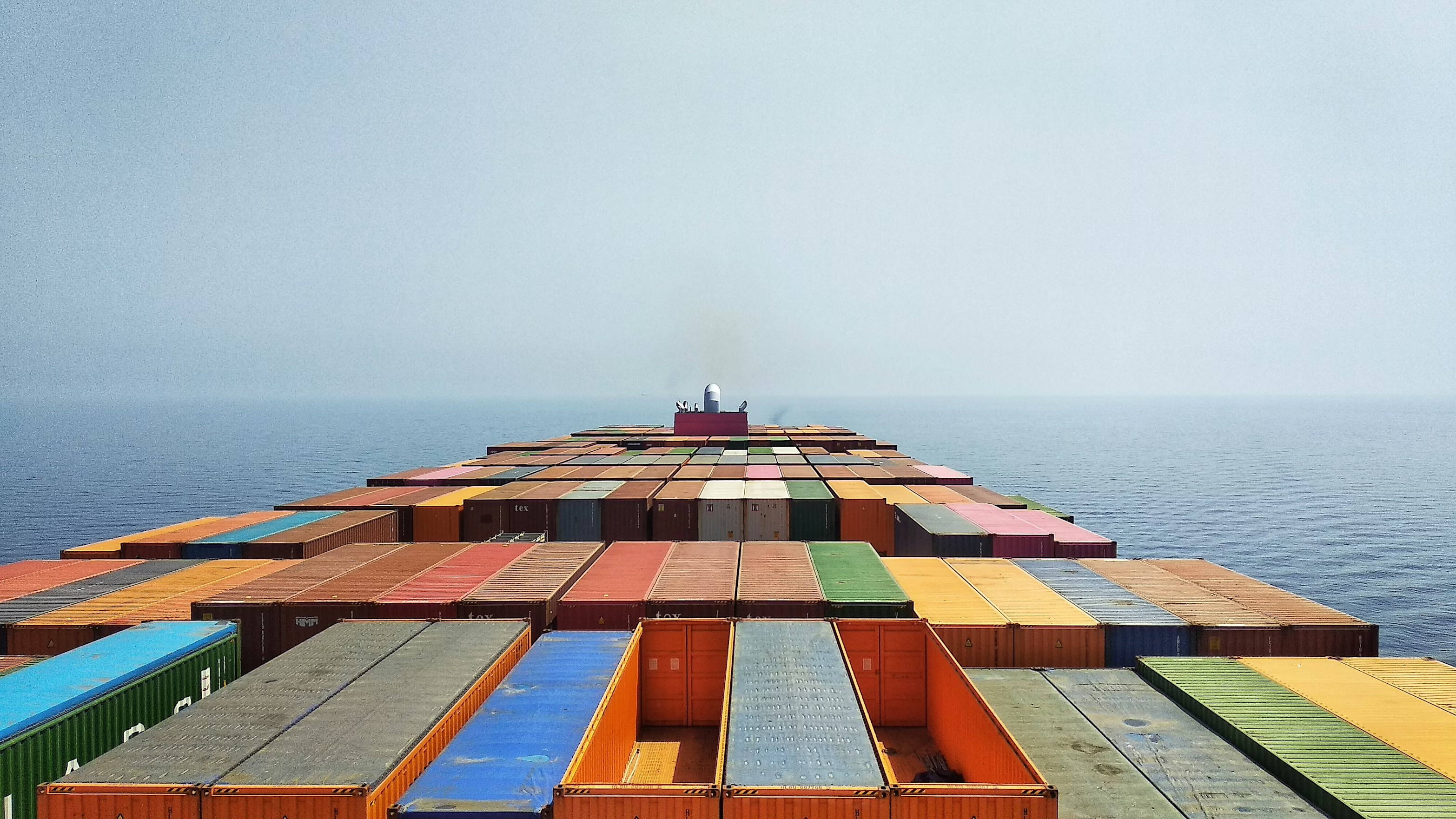
Shielded from foreign competition by the Jones Act, U.S. shipbuilders face little pressure to innovate or reduce costs. In competitive global industries, inefficient firms are displaced; under the Jones Act, however, domestic shipyards are insulated from that discipline. The consequences are clear: The number of large U.S.-flagged commercial ships plummeted from 2,926 in 1960 to just 188 in 2025 — a 94% decline — even as the global fleet more than doubled over the same period. Most importantly, of the more than 6,100 container ships in the global fleet, fewer than 30 comply with the Jones Act. These worsening conditions both stem from and further intensify the already damaging economic effects of the Jones Act.
These costs, however, are not borne equally. The Jones Act creates severe price distortions for goods shipped between U.S. ports, with the effects falling most heavily on non-contiguous jurisdictions that cannot substitute maritime shipping with ground transportation. A Federal Reserve Bank of New York study illustrates the magnitude of these distortions: In 2012, shipping a twenty-foot container from the mainland United States to Puerto Rico cost $3,063, compared to just $1,503 to the Dominican Republic and $1,687 to Kingston, Jamaica.
Furthermore, these distortions extend beyond freight pricing by reshaping domestic energy markets and forcing regions of the United States to rely on foreign natural gas suppliers. Hawaii, for example, imported 100% of its propane from Canada last year, even as millions of barrels of U.S. propane passed nearby en route to Asia. Puerto Rico pays up to 30% more for liquefied natural gas (LNG) because no Jones Act–compliant carriers serve the route. Accordingly, in 2021, the United States supplied just 0.002% of Puerto Rico’s natural gas imports, whereas the nearby Dominican Republic obtained 96.4% of its LNG from American suppliers. With no Jones Act–compliant gas carrier built since 1980, it is unsurprising that Puerto Rico and Hawaii face some of the highest energy costs in the country.
The distortionary effects of the Jones Act also meaningfully constrain domestic commerce within the mainland United States. Despite the presence of LNG terminals in nearby Georgia and Maryland, New England frequently relies on foreign sources of natural gas because the Jones Act drives up the cost of domestic LNG shipments, making these routes economically unviable and increasing the region’s LNG costs by an estimated 10 to 30 percent. More broadly, there is evidence that otherwise efficient domestic shipping routes are underutilized across the United States. For example, the Congressional Research Service reports that only about 2% of all U.S. freight is carried by ships. Despite the massive growth in coastal U.S. cities since the 1960s, coastwise shipping tonnage has actually declined by roughly 44% over the same period. All other modes of freight transport, including international shipping, have either increased or remained steady. In addition to the lost surplus attributable to more costly transportation options, the World Economic Forum estimates that preventing foreign ships from transporting cargo between United States ports costs the United States economy $200 million per year.
Even if one were to accept these economic costs, the national security rationale for the Jones Act has grown increasingly questionable, as protecting the domestic shipping industry no longer enhances naval readiness. Today, only one of the five shipyards that produce major vessels for the Navy and Coast Guard builds commercial vessels that are compliant with the Jones Act. Almost 90% of the cargoes carried in the Iraq and Afghanistan wars were carried on U.S.-flagged ships, but none of them were Jones Act-compliant. More broadly, 91% of the 911 vessels built in U.S. shipyards between 2007 and 2017 were sold domestically. If Jones Act-compliant ships cannot compete internationally, and are not used during times of war, then what national security benefits do they actually provide?
In light of the Jones Act’s considerable economic harms, it is clear that this law fundamentally privileges a narrow set of maritime interests over American consumers. Reform, however, is far from straightforward. Despite decades of criticism and blatantly uncompetitive outcomes, it has endured with little indication of repeal. For that reason, the most pragmatic path forward may not lie in outright repeal, but in targeted reforms that preserve domestic oversight while restoring competition. Expanding Jones Act compliance to foreign-built ships owned by American companies, for example, would enhance domestic connectivity and lower prices without ceding control of U.S. shipping to foreign entities. The Trump administration’s recent agreement with South Korea, which includes a $150 billion investment aimed at supporting South Korean firms’ entry into the U.S. shipbuilding industry, suggests that incremental progress is possible.
If the economic case for reform is clear, the political case is far more complicated. Reform is consistently stifled by a well-organized and powerful maritime shipping industry that benefits from the law’s diffuse costs and concentrated gains. Its defenders exploit the difficulty of precisely estimating the law’s full costs to cast doubt on efforts to quantify its magnitude, while simultaneously appealing to moral authority by framing the law as essential to national security and the protection of American jobs. However, it is increasingly disingenuous to defend a grossly uncompetitive American shipping industry that struggles to serve even its domestic customers. Why should American consumers pay to protect an industry that consistently inflates prices, restricts trade, and even fails at its central purpose of enhancing national security? The answer is simple: If you provide monopoly protections, those who benefit will fight tooth and nail to preserve them. Amidst deteriorating conditions, this arrangement must give way.
The Jones Act is fundamentally designed to monopolize the shipping industry, shielding the industry from competition and causing both higher prices and lower output than what would occur under international competition. If the Trump administration truly wants to “Make American Shipbuilding Great Again,” it must prioritize Americans over a handful of uncompetitive American ships.