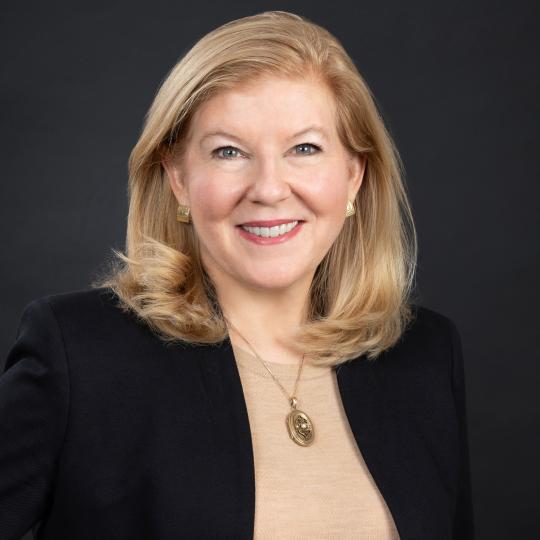
Aimee Guidera has spent her career working to improve educational opportunities and outcomes for students. Most recently, as Virginia Secretary of Education, Guidera helped strengthen curriculum standards, while expanding opportunities to early childhood education and increasing transparency in higher education outcomes. The Harvard Political Review sat down with Guidera during her fellowship at the Institute of Politics to discuss the role and importance of public schools in American society as well as her accomplishments in serving in the Youngkin administration.
This interview has been edited for length and clarity.
Harvard Political Review: I’d like to start by getting your view on the current state of the American education system: what’s working well, what’s working badly, where we’ve been, and where we are headed.
Aimee Guidera: We are at a moment right now where there is a huge amount of change. Everything from “what is the federal role in education?” to “where should decisions be made?” and “how should money be distributed?” It’s also a changing conversation with the American people about trust in education and the public system. So for the first time ever in higher education, fewer than half of Americans see a four-year degree as being a worthwhile investment. You have an economy that is not valuing the four-year institution degree, the B.A., as much as possible, as it used to. Short-term credentials are now becoming the coin of the realm. Now we have large corporations that are not requiring bachelor’s degrees as a prerequisite for being hired, and many state governments, including Virginia, are doing the same.
It drives back to the question of what is the purpose of education? I personally believe that education has three purposes. The first is to ensure that we are preparing every generation to be successful, productive members of our economy. Do you have economic social mobility as a result of spending that time in education? Are you better off? Are you prepared for what the changing economy requires? The second purpose of education is to produce engaged and informed citizens who can participate in our increasingly pluralistic democracy. This is a place that I think we are really failing at, understanding how you get to have a productive conversation in a messy democracy. The third purpose, which I believe deeply in, is how we prepare people to be engaged as good neighbors in our communities. This one is often not popular with conservatives, who say that’s not the job of education. I think it is. So often when we talk about government, and we talk about civics, it’s about rights, and I think that we have gotten so far away from responsibility, what it means to be a good citizen, a good neighbor, and a good productive member of our economy. To me, education has a role in all of that. To your broader question, though, I’m also really worried about where we are.
When I graduated, I did my senior thesis, more than 30 years ago, at Princeton. At that point, the Nation at Risk report had come out, and we were starting to see the slide of America’s education system being the envy of the world, and there were questions over whether we were in a similar moment. I would argue our higher education system is still the envy of the world now, and yet I think we are losing not because we’re getting worse, but because everybody else is gaining, and that’s also the story with K-12. The real story here is that other nations have learned from us, and they are going gangbusters, and we have not kept up with that. To me, it is something that we have to focus on.
My entire career has been focused on high expectations for every child. This makes us uniquely positioned in the world and is why public education matters. This excellence should be available to every single family, and, as the game-changer, it’s how the American dream becomes a reality. I had an incredible, incredible education in Montgomery County public schools, 13 years, kindergarten through 12th. I just thought that was normal, and that’s what every American child had. That is what has driven me in my career, helping to change American education so that what I experienced, which was exceptional, became the norm. But we have a long way to go.
HPR: You were the Secretary of Education for Governor Glenn Youngkin of Virginia, someone who made education the forefront of his candidacy and governorship. What are some of your proudest accomplishments?
AG: Serving as Secretary of Education was the honor of a lifetime. My dream job was to work for a governor who believed that education was the most important issue he or she could work on because it changes everything. I waited 35 years and got a chance to work for him, which was extraordinary. The Youngkin administration’s goal was to restore excellence to education in Virginia and to ensure that every Virginian had access to that excellence.
We had huge investments in early childhood education. When great policy and great leadership come together, it’s not about politics. One of the real assets that Virginia had was one of the leading experts in early childhood education serving in the Department of Education. She had been brought up by the prior governor, a Democrat, and the First Lady, who wanted to make early childhood her issue. Now Jenna Conway is the state superintendent [of public instruction], appointed by Governor Abigail Spanberger, which is awesome.
Early childhood education is a nonpartisan issue, which we need more examples of. It’s not political, just good policy working for kids. With the governor, we put close to a billion extra dollars into early childhood over our time in office to expand the amount of scholarships that were for families in economic need. The really important part in our childhood education is that our entire system is based on quality, and quality that is defined by metrics, hard data, and that is easily accessible by anybody in the state.
On the K-12 piece, we focused on ensuring that there was transparency about where every child was and that we were holding the adults in the system accountable for results. We redid all the standards, our course standards, history, civics, English, math, and science. We increased transparency; you can go to the website and find out how well every school is serving every student. Our mission then was, how do you transform the culture around data and education from being one of a hammer to being one of a flashlight, using data as a tool for empowerment, improvement, and for every single family to understand how well their child is doing?
For higher education, it was about restoring excellence and making sure that we’re preparing every graduate for success in life, and they were forming pieces. It was all about affordability and access, making sure that we are keeping costs low and that we’re being strategic, making sure that we stop doing things that aren’t actually serving students well. How do we make sure that there’s a focus on not just inputs, but on outcomes as well?
One of the things I’m most proud of is that we launched a college outcomes portal that you can go on now and look at, understanding the return on investment. We’re creating this whole hub where I can go on and ask, what are the greatest jobs and the demand for the skills? Where can I go to get those jobs?
It really is about changing how we use data for people to make better decisions, to have greater efficiency and greater effectiveness, and make better decisions. The other piece that we did was talk with the university presidents, and one of the things I think is noteworthy, I was proud of, is for the first time ever, the governor and I would sit down on a quarterly basis with every one of the presidents together, the council of presidents. The presidents would say, we’ve never had this much access to the governor before. It was CEO to CEO conversations.
HPR: Education in the United States has a decentralized structure, day-to-day policies are implemented on the local level, and the federal and state governments each provide some level of oversight and support. What are your thoughts on this structure?
AG: I believe deeply that decisions are best made as close as possible to the people impacted by the decisions, especially in education and communities. That’s why we elected local school boards. I would argue they’re probably the most important policymakers in our entire government because they are making really important decisions about how money is spent, time is spent, and educating our future generations.
Some of the most frustrating conversations I have with people are when I get phone calls, and [they] say, “We really don’t like what our school division’s doing,” which is what we call them in Virginia, “Can’t you fix this?” I say it’s called democracy; it’s really messy. You need to go to your board, talk to your neighbors about this, and try to influence the conversation, and if you go, that’s how you get involved in the elections, and try to change that.
Why I work at the state level is because of its ability to make the critical decisions about academic standards and accountability systems. If that is done well, you create incentives that are for everybody, the right thing, and to get every child what he or she needs, then those are the decisions, the how you do it. The “what” is decided at the state level; how you do that should be left at the local level.
Traditionally, in this country, the federal government has had a very small role, providing roughly 10% traditionally of funding. But I would argue the most important role in the federal government is to provide data, and access to best practices, and what we learned around the country, and compensatory funding, such as Title I, and different pieces, which is really important. As someone who believes so deeply in accountability, an accountability hawk, when we have had a strong accountability system mandated by the federal government, we have seen student achievement rise. In the years after the passage of the No Child Left Behind Act (NCLB), we saw rises in achievement for all students.
As a conservative, I believe deeply that the powers reside at the local level, and yet there’s a very important role at the state level, and my ask of the federal government is two things. One, continue the National Assessment of Educational Progress (NAEP), because that truth serum of having that, every other year, be[ing] able to look and see what’s going on, that is incredibly important. It’s also really important that the quid pro quo is that, forgetting any kind of federal dollars that you won, you do NAEP testing, and that you have to have transparency, to report on your every school’s results, and two, that there needs to be accountability. Those are the most critical pieces to me. The federal government has, ultimately, been encouraging states to do the right thing.