It starts with fear. Then bureaucracy. The oaths, the parades, and the propaganda soon follow. What was once a daring story conceived in a galaxy far, far away is becoming frighteningly familiar.
In September 2022, the first season of “Andor” premiered on Disney+, marking a gritty, bold, and notably more political shift in the “Star Wars” franchise. The series follows the story of Cassian Andor, a thief and smuggler, as he embarks on a journey that explores the early rumblings of resistance and political unrest throughout the galaxy. In its second season, the series intensified its most provocative theme: the subtle and gradual rise of authoritarianism. What has led the show to be rejected by some audiences is not its lack of lightsabers or Jedi, but its unsettling resemblance to our current world.
It is worth noting that “Star Wars” has always been an inherently political sphere of media that frequently discusses real-world issues, such as injustice and inequality. The context for the original trilogy of the “Star Wars” universe finds its roots in the Vietnam War. The Vietcong, the Vietnamese communist movement, was portrayed as the “little guys,” who defeated the United States, just as the Rebels defeated the Empire.
However, what makes “Andor” so chilling is that it does not imitate real-world events; rather, it seems that real-world events imitate it. Comparisons between the Trump administration and the Empire are not new, but the second season of “Andor” brings these parallels into sharper focus. Through its depiction of state propaganda, bureaucratic oppression, and nationalist rhetoric, the series transforms a galaxy far, far away into a striking reflection of modern American politics.
A significant comparison between the Trump administration and the Empire is their use of propaganda to distort truths and dehumanize vulnerable populations. In “Andor,” propaganda is weaponized against the Ghorman people, an ethnic group on the planet of Ghorman, to manipulate public perception. The Empire portrays the once-great Ghorman people as elitist, primarily through a seemingly innocuous television show, effectively erasing any public support for them and causing their product-based economic system to collapse. This situation is exacerbated by the memory of Grand Moff Tarkin, who killed hundreds of Ghormans by landing his Star Destroyer directly on top of them. When the Ghormans attempt to resist this brutal suppression by holding peaceful protests, the Empire responds with overwhelming bloodshed. This ruthless act, the Ghorman Massacre, was framed as a necessary show of force against chaos.
The Empire’s authoritarian power reaches its apex when propaganda permeates every facet of life in the Empire’s capital, Coruscaunt. One of the most notable instances of propaganda in “Andor” is embodied by Syril Carn and his mother, Eedy Carn. Syril works with the Imperial Security Bureau, the Empire’s equivalent of the FBI. He understands the inner workings of the Empire’s propaganda machine and therefore clashes with his mother on how she perceives the Ghormans. In one scene, Eedy casually remarks that “the Ghormans have always thought they were better than everyone else.” Syril pushes back lightly, saying she has been “watching too much Imperial News.”
The Empire’s technique, which is to first dehumanize and then dominate, clearly echoes central strategies of the Trump administration’s deportation efforts. In February 2025, the White House posted a shockingly stylized ASMR-esque video to Instagram. It showed undocumented immigrants being shackled, loaded onto planes, and deported, all accompanied by soothing background music and the clanking of shackles. It was propaganda wrapped in the guise of satirical internet content, which only served to emphasize the “us versus them” narrative that the White House has been spinning since January.
In these two dystopias, one in a galaxy ruled by an Emperor, the other in a country run by an administration dominating via chaos and fear, propaganda serves to transform public perception against a vulnerable group. In doing this, propaganda makes it more politically viable to take unconscionable action against innocent people. In essence, if you control the story, you control the people.
Another point of comparison between the Empire in “Andor” and the Trump administration involves how they mirror the births of other authoritarian regimes, which rarely announce themselves with dramatic actions. More often than not, these regimes begin to slowly consolidate power by creating paperwork and unnecessary procedures, both of which serve to suppress ordinary people. In “Andor”, the Empire’s vast bureaucratic machine is one of its most dangerous weapons.
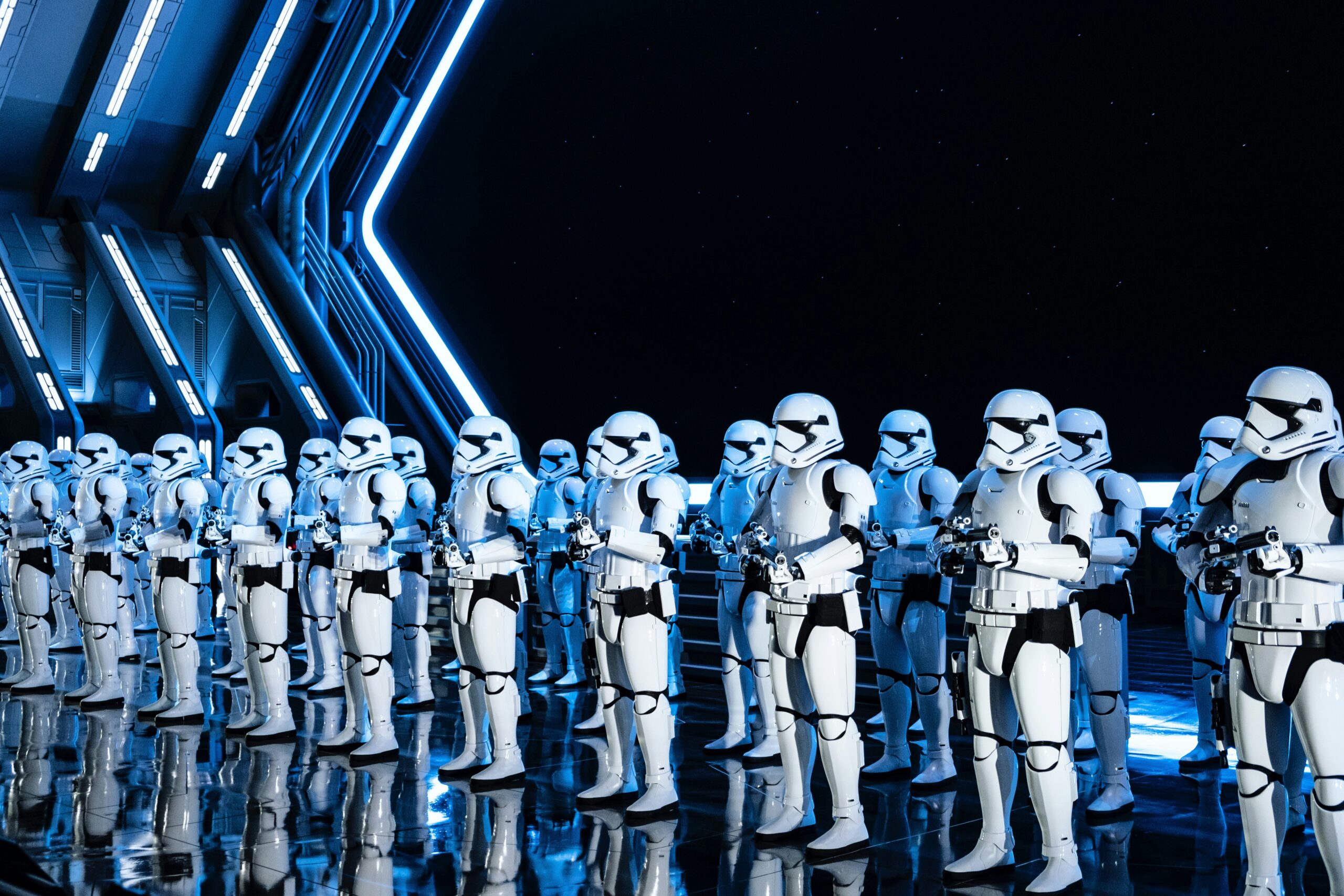
The arrest of Sen. Dasi Oran from Ghorman exemplifies this tactic. His only crime? Being Ghorman. Even after he refuses to oppose the Emperor, Stormtroopers arrest Sen. Oran with no official reasoning. Instead, the imperial machine only feeds rumors by making vague statements about security protocols, which leaves people to speculate on why a highly-regarded Galactic Senator is being treated like a criminal.
A similar event unfolded in the United States earlier this year, when Secretary Kristi Noem’s Secret Service tackled Sen. Alex Padilla, D-Calif., for raising concerns during her press briefing. The justification the White House gave for an act never seen before in our 250-year history was lackluster, citing “Non-compliance with officers.” While he was released shortly after the incident, the sheer fact that a high-ranking U.S. official could be forcibly arrested for raising valid concerns is, at best, frightening. Although this administration, unlike the Empire, is seeking to shrink the U.S. bureaucracy, what makes this incident notable is that this supposedly shrunken bureaucracy selectively shields authority figures, justifies aggression, and obfuscates any sense of responsibility. Just as the Empire utilized its complex system of rules and departments to advance its agenda, the Trump administration employed its bureaucratic system to evade accountability for the incident.
No matter what world the story takes place in, the fact remains that placing an institution’s power above fundamental truth and the people it purports to serve is a severe miscarriage of justice. When injustice is tolerated, the seeds of authoritarianism have already taken root.
The final comparison focuses on pride, which is especially important in the context of building national identity. However, pride within an authoritarian institution is not authentic; rather, it is carefully manufactured, often grounded in military strength and blind allegiance. In “Andor,” the Empire demands not only obedience but also wholehearted devotion. This devotion is embedded within the Senate, where every session begins with a formal oath of loyalty to the Empire. The language of this oath is grand, the tone is unwavering, and the oath itself is explicitly performative. Senators, even those who may disagree in private, affirm the Empire’s supposed mission of “peace through strength,” a phrase President Trump has coined as his own.
The Empire’s version of nationalism is tied to military superiority, just as the Trump administration’s also is. One of the children of this national vision was born on June 14, 2025, which is both President Trump’s birthday and the U.S. Army’s 250th anniversary. To celebrate them jointly, the Trump Administration orchestrated a full-scale military parade with tanks, jets, and salutes, in a spectacle that rivaled similar events held annually in Russia and China. It represented a critical break from typical Army procedure and was an explicit projection of power draped under the guise of patriotism.
In both cases, the blending of nationalistic spectacle and political messaging create a dangerous illusion — one where strength equates to virtue, and that state allegiance is of the greatest moral importance. In “Andor,” the Empire uses oaths to hide any signs of disloyalty; in the same vein, the Trump administration uses parades and slogans to skew the common perception of the administration and equate honest criticism with a lack of patriotism.
Militarized nationalism may seem harmless at first, but it is often one of the final stages of authoritarian control. After the process of authoritarianism erodes the truth and people have been dehumanized, the ideals of democracy slowly drift away. And once that process takes hold, any tyrant can justify any heinous act in the name of achieving “greatness.”
As Senator Mon Mothma, the mother of the Rebellion, said in her daring speech in front of the Senate, “The death of truth is the ultimate victory of evil. When truth leaves us, when we let it slip away, when it is ripped from our hands, we become vulnerable to the appetite of whatever monster screams the loudest.” Her words cut to the heart of authoritarianism because authoritarianism sets in as a silent erosion of truth, justice, and free will.
“Andor” reminds us that tyranny does not rise overnight. It builds its influence slowly through propaganda, bureaucracy, and performative nationalism. And if we fail to speak the truth while we still can, just as Senator Mothma did, we risk becoming the very Empire we once thought only existed in a galaxy far, far away.

Associate World Editor, Comp Director