

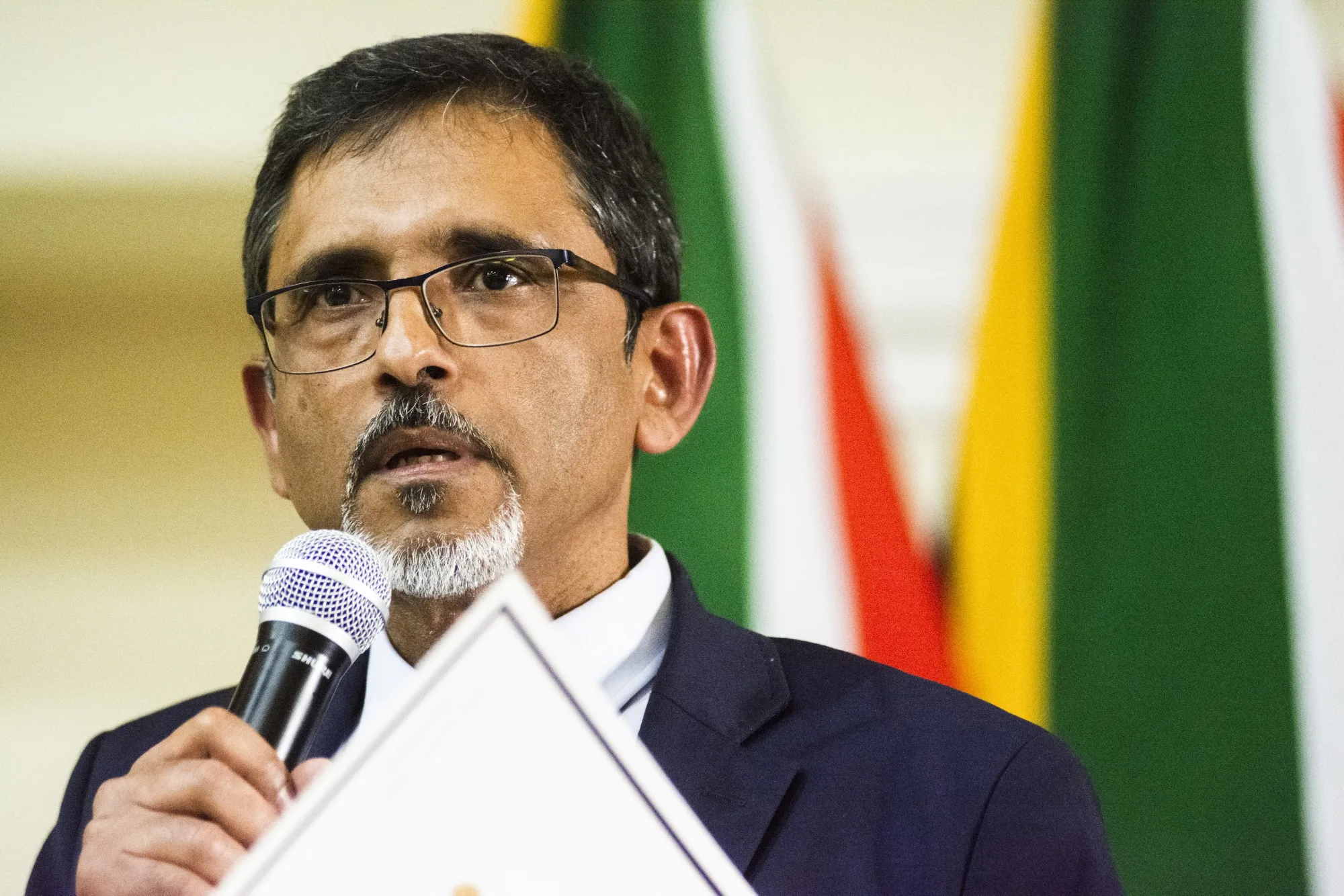
Ebrahim Patel served as South Africa’s Minister of Trade, Industry, and Competition from 2019 to 2024 and as Minister of Economic Development from 2009 to 2019. Patel began his career in the trade union movement, where he played a leading role in shaping South Africa’s post-apartheid labor and industrial policy. He has acted as the Chief Negotiator on the Labor Relations Act of 1995 and the President of the South African Labor Research Institute. Over his 15 years in the Cabinet, he drove initiatives on industrialization, competition reform, and regional integration, including the African Continental Free Trade Area. The Harvard Political Review sat down with Minister Patel to discuss the future of African industrialization, the lessons of the South African labor movement, and the balance between globalization and shared prosperity.
This interview has been edited for length and clarity.
Harvard Political Review: How have your roots in the labor movement — as Secretary-General of Southern African Clothing & Textile Workers’ Union — shaped your approach to economic policy and mindset as a Minister?
Ebrahim Patel: Trade and economies are fundamentally about people, and somewhere in the making of rules, which are all necessary, we have placed less emphasis on the ultimate objective of economic policy, which is enhancing the quality of life of all the citizens and residents of a country. My experience as a trade unionist has made me alert to the anonymous people who make the economy run: the steelworkers, the autoworkers, the service-sector workers who serve us, the people who grow the food that we consume, and the digital workers.
Being alert to that means that when I consider policies, I think of the impact they will have on people. It’s not only the potential negative consequences and how to mitigate or avoid them, but also the potential to enhance lives. If we can construct policies that speak to the human beings who are the objectives of policy, then those policies will be better. Economics is about trade-offs, about choosing between options, each with its own advantages and costs. Those costs and benefits are not distributed equally. Policymakers who are aware of the distributional effects of policies can compensate for them and choose policies with wider reach. If a country’s GDP increases dramatically but the benefits are captured by only a small number of people, then the welfare of that country is lower than one that grows at the same rate but with a more equitable distribution. So, what the labor movement does is alert you to those distributional effects — and that awareness has been significant for me.
HPR: What are some of the policies that could help smooth over distributional inequalities and move South Africa in the right direction?
EP: One of the country’s key focuses now is increasing trade between and among African countries. We’ve developed the African Continental Free Trade Area to incentivize more intra-African trade. We’re also working hard to improve the infrastructure that supports regional trade, like transportation, energy systems, digital infrastructure, and water systems. This is so that we can attract investment and ensure that marginalized parts of the continent can join the economic mainstream.
It’s striking that many of Africa’s most significant rail lines simply connect mining pits to ports of exit. They don’t connect economies and cities. That kind of infrastructure builds an export-focused economy and policies that uphold it. But if we develop infrastructure that connects African countries to each other, we create opportunities to industrialize, to process our own raw materials, and to sell more value-added goods to the rest of the world.
HPR: What, in your eyes, is Africa’s biggest trade challenge now?
EP: Africa’s big challenge is that it does not produce what it consumes and does not consume what it produces. It exports raw materials and imports finished goods. A more balanced economy would narrow that gap by producing more of its own consumption locally. During the COVID-19 pandemic, we worked hard to secure waivers to certain World Trade Organization rules on intellectual property, so that developing countries could use vaccine technologies to produce locally and save lives. Without that, Africa would have been at the back of the queue for access to vaccines and faced unreasonably high prices.
Through collaboration with other developing countries, and eventually with the support of the Biden administration, we secured waivers and reached agreements with two major pharmaceutical companies to produce vaccines in South Africa. We supplied them to the rest of the continent and even to the European Union.
That shows the benefits of a world in which production is not concentrated in only a few countries. For me, it illustrates the value of the kind of work we’re doing. The lesson, in a way, is that if there’s a will, we can do these things. We don’t always need a crisis. The human mind and imagination enable us to do the right thing even without one. During the Great Depression, the United States reimagined its society through the New Deal and worked on creating a fairer economy. We must marshal the world’s energy to improve our societies now.
HPR: Given the Trump administration’s increased tariffs, what is your outlook on how America’s trade strategy will impact countries like South Africa? What should South Africa’s response be?
EP: The raising of tariffs in the manner we’ve seen creates significant stress for American consumers through higher prices, disrupts supply chains, and leads to a more insular world. If other countries retaliate, we’ll end up in a “beggar-thy-neighbor” situation where everyone is worse off.
For South Africa, part of the response is to diversify trading relationships, recognizing the concentration risk of relying too heavily on a constrained export market. At the same time, we need to make the argument to the American people that it’s in their interest for American workers to have access to South African products — including raw materials that power U.S. industries — and that South African workers should have access to the American market too.
Both sides benefit when American companies can export to South Africa without punitive tariffs, and South African companies can export similarly. A great example is the African Growth and Opportunity Act, supported by both Republican and Democratic administrations, which granted countries in sub-Saharan Africa preferential access to the U.S. market. The principle was that development should rest not on aid, but on trade.
Africa faces an enormous demographic shift: By 2050, more than half of all new births globally will be on the African continent, and our population will almost double, even as most other regions shrink. The world will face a shortage of young workers, while Africa will have more of them. The solution cannot be to export people; it must be to create jobs within Africa. So there’s a compelling argument that it’s in everyone’s long-term interest to promote African development. As I often remind people, we’re all Africans ultimately — humanity’s roots began on our continent. Our task now is to remember that fundamental connectivity.