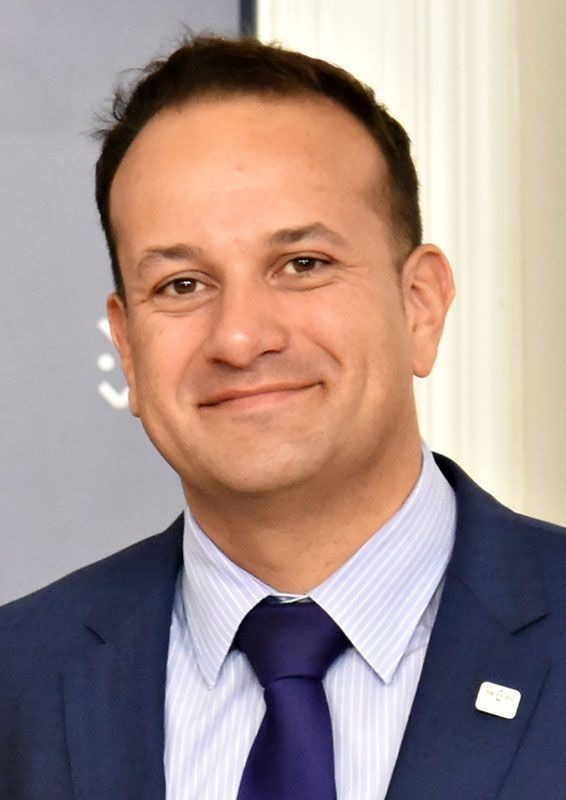
Leo Varadkar served as Taoiseach of Ireland, the Irish equivalent of prime minister, from 2017 to 2020 and again from 2022 to 2024. He led Ireland through the COVID-19 pandemic, Brexit negotiations, and historic expansions of civil rights. A medical doctor, Varadkar also served in cabinet for over a decade across the areas of Transport, Enterprise, Social Protection, and Health. As taoiseach, he oversaw record employment, a growing budget surplus, landmark climate legislation, and major investments in public infrastructure, workers’ rights, and international development. The Harvard Political Review sat down with Varadkar to discuss leadership through crises, Ireland’s evolving role in Europe, and the challenges of building unity at home.
This interview has been edited for length and clarity.
Harvard Political Review: You’re a trained general practitioner, not a career politician. How did your experience outside politics shape how you related to ordinary citizens, and did you ever feel that connection strained by the pressures of high office?
Leo Varadkar: First, I think it is a good idea to have had a real job before you go into politics. It was probably my mother’s influence more than anything. She was very adamant [that] I have a career to fall back on, because politics is very volatile.
I see people who go straight from university to working for a congressman or a parliamentarian and never really have any experience for the rest of their lives. They never know how to get out, because it’s all they’ve ever done. So that was a plus for me, certainly, but also a lot of the skills are transferable: the scientific way of thinking and looking at data and evidence, and the ability to explain complicated concepts to people in language they understand. It’s important to get people on your side for the medicine you’re about to give them.
Harvard Political Review: You temporarily returned to medical practice during the pandemic. How did being both a frontline doctor and taoiseach shape your understanding of leadership and your handling of the crisis?
Leo Varadkar: We had a special registration for health care professionals because we needed retired people to come back. I couldn’t practice fully, but I was able to do certain things. In the early phase, I was helping out with contact tracing, and that was only a few shifts, but I was trying to show solidarity with the frontline staff and trying to show some leadership. When the vaccines arrived, I was able to help out with the vaccine program. That was great, because they were very happy patients, mainly people over 70, people with an underlying condition for whom a vaccine represented freedom.
Harvard Political Review You often speak of Ireland remaining at “the heart of Europe.” In an age of increasing nationalism and fragmentation, what does that commitment look like in practice?
Leo Varadkar: Mainly, it looks like standing in solidarity with other EU member states. We help each other out when in trouble. It also means a commitment to what you can read in all of our treaties, a culture where we’re citizens of a single market and single currency. We seek to deepen that relationship over time, but with the consent of the people.
It means that we support having other European countries come onto this EU path. The most obvious example is Ukraine. They really want to be part of the EU and don’t want to be under the control of the Kremlin. So we are always supporting them in their efforts.
Harvard Political Review: You passed a climate law with binding targets. What’s the next step in building climate resilience into Ireland’s planning? Is mitigation or adaptation more important for Ireland?
Leo Varadkar: It is a combination of mitigation and adaptation. Mitigation is about changing our energy system from one that’s fossil fuel-based to ones that are mainly renewable and nuclear. It means changing our food systems as well, which I think is difficult and controversial for people. It certainly was in Ireland, where there’s a big, big beef and dairy sector.
It also means changing our transport systems so that they’re based on walking, cycling, public transport, and, where possible, electric vehicles. We also have to consider using synthetic fuel for heavy vehicles and for aviation, and then changing the way we build and heat our buildings. I think it’s all doable.
Mary Robinson, who formerly served as president of Ireland and was a U.N. high commissioner, said something very true about climate. She said we’re on the verge of two things: a climate breakdown that’s irreversible, and deploying the technologies that we already have to make sure that doesn’t happen. It’s a very kind of tenuous race between the two.
Harvard Political Review: You’ve championed a “Shared Island” vision. What would a truly unified Ireland look like to you — economically, culturally, and institutionally? And how soon is too soon for a referendum on unity?
Leo Varadkar: Shared Ireland isn’t necessarily about unification, but rather about closer cooperation between the North and South. We were careful to keep that distinct. Given the very strong budgetary position we’re in, we’re in a position to help out with passport projects and infrastructure projects. I don’t think I can prescribe what unification should look like, although I’d like to do a bit of work or even write something on it.
There are lots of different models — there are federal models and models that would continue to have autonomy. In Northern Ireland, there’s a unitary state model with lots of local government. I’m definitely keen not to prescribe a single model for how things should look, but I think we should have that conversation.
There are a lot of people, North and South, who want to have that, even if it is just so they can reject the offer. There are other people who would prefer this notion to just go away and don’t want to rock the boat. I think, nearly 30 years after the Good Friday Agreement, that’s not the right approach.
Harvard Political Review: You and current Taoiseach Micheál Martin led Ireland through a historic rotating Taoiseach arrangement after the 2020 general elections, a first in the state’s history. Martin served from June 2020 to December 2022. And you took over until stepping down in 2024. What was this experience like?
Leo Varadkar: We have a multiparty system, and a coalition of both our parties was needed to form a majority in the parliament. We were within 1% or so of each other in terms of the vote. So we decided we’d split the Cabinet post equally, and that we would rotate the office of the prime minister. It had been talked about before, but Ireland had never done it. I think we made it work because of our personal trust, good faith, and no surprises. It’s also in part because we had to deal with the pandemic and other crises. People in other parts of Europe, where coalitions are the norm, were fascinated by it. They tried to do it in Bulgaria, but the agreement didn’t hold. The closest they’ve come is in Israel.
Harvard Political Review: Do you believe the rotating taoiseach model should ever become a formalized part of the Irish political structure, or was it a one-off solution to an unusual political moment?
Leo Varadkar: I don’t think it should become the norm. It worked in the circumstances we were in, and that arrangement has now continued with the new government, with the new leader of my party [Simon Harris of the Fine Gael party], and Micheàl Martin is the leader of his party [Sinn Féin].
But it only really works when the result of the election is so close that it justifies it. If there was a bigger gap, it’s tough. In Luxembourg, Norway, and a few other places, they’ve had the prime ministers come from a party that’s not the biggest in the coalition, and I think it would be even harder to make that work.