

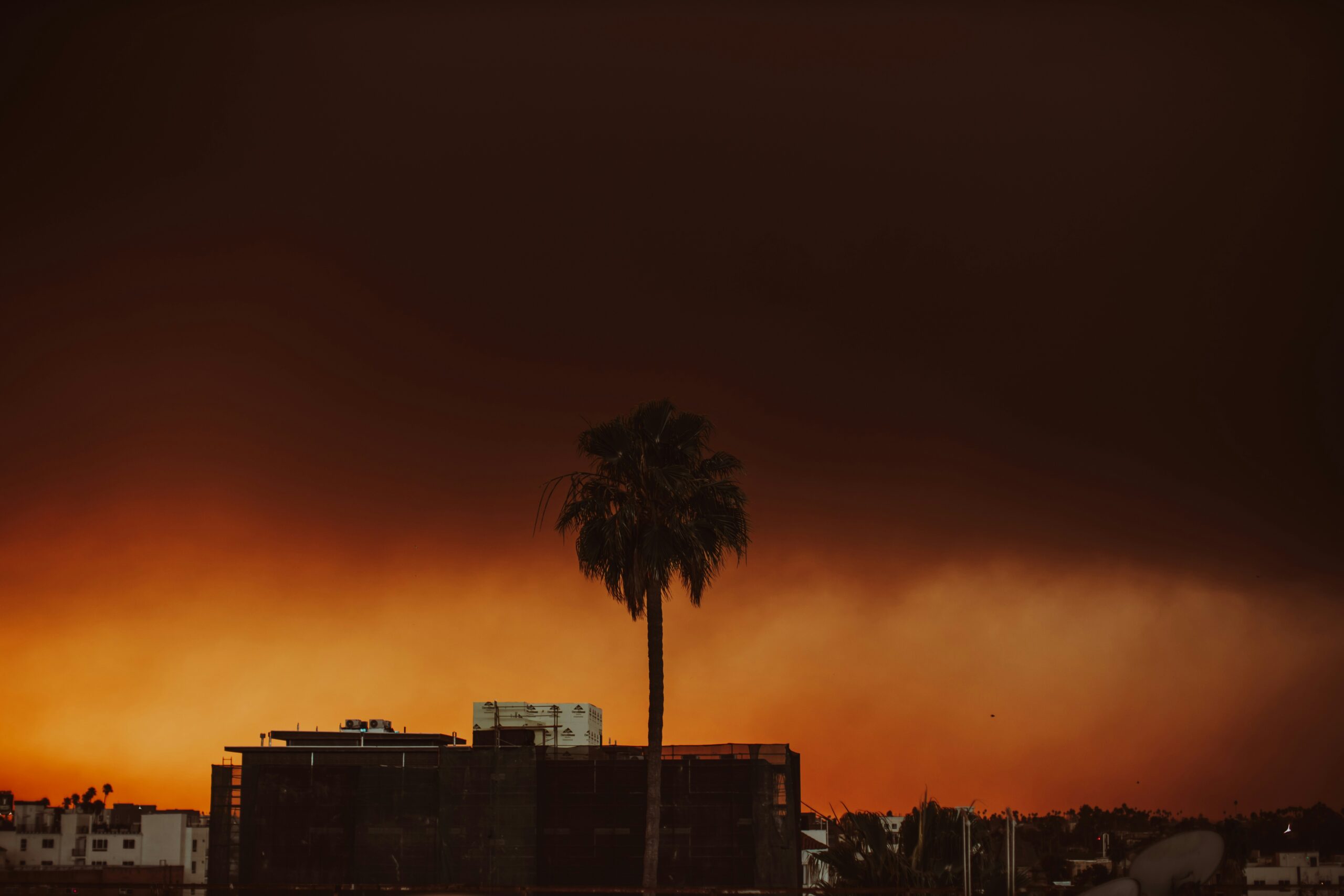
When I was eight years old, I stood on my friend’s hillside balcony, watching an orange glow creep to the top of a faraway mountain in Malibu. A wildfire had broken out. I asked my dad if a wildfire would ever reach us. He scoffed, shaking his head confidently, and said, “LA would never let the Palisades burn.” For most of my childhood, I believed him.
Almost 10 years later, on Jan. 7, 2025, I drove through walls of flames to escape my own neighborhood. The Palisades wildfire did not just come close; it had wiped out the town I called home. Almost a year later, as I watch my hometown slowly rebuild, I come back to the same question: What, if anything, has changed?
The Palisades fire was both a climate disaster and a failure of governance and trust. My community’s recovery has brought into question who accountability falls upon and who must take it upon themselves to rebuild when government neglect adds fuel to the catastrophe.
Only after 24 days was the Palisades Fire finally contained, having destroyed 23,448 acres and 6,837 structures. Twelve lives were lost, and an additional 1,017 structures were damaged. Pacific Palisades had spanned 23,431 acres and contained 9,400 residential units and businesses. In just over three weeks, an entire town was reduced to ash.
Layers of Neglect: What Caused the Fire?
In the early hours of New Year’s Day of 2025, the Lachman Fire started in the same brush area as the Palisades Fire but only burned around eight acres of land and caused no harm to buildings in the area. On Oct. 8, 2025, an arson suspect was arrested under suspicion that he lit the Lachman Fire. The suspect expressed disturbing behavior, consulted ChatGPT for images of a burning city, and was seen in the area where the Lachman Fire started. While there is still no known direct cause of the Palisades Fire, a leading theory suggests that it may have been a reignition of the Lachman Fire, which may have smoldered undetected and been rekindled by the strong Santa Ana winds.
A multitude of systemic failures are believed to have intensified the fire’s spread and delayed containment. After several hours of firefighting, the hydrants in the area ran dry, and firefighters were unable to save homes and businesses. Yet Los Angeles Department of Water and Power (LADWP) officials maintain they never ran out of water and instead, they simply had no system physically able to fight such a large fire. In a wildfire-prone city like Los Angeles, the question remains: If the hydrant system was not built to fight fires like this one, what exactly was it built for?
The Santa Ynez reservoir, adjacent to the Palisades Highlands neighborhood, could have provided 117 million gallons of water. The problem? The reservoir was emptied in 2024 due to a tear in its protective cover that prevented debris from falling into the reservoir. It was never refilled.
Jeremy Padawer, a longtime resident of the Pacific Palisades and Chief Business Officer of the Jazwares Toy Company, has been an outspoken critic of local government since the fires. In an interview with the HPR, Padawer called the lack of urgency to fix the reservoir “pretty diabolical.”
The Los Angeles Fire Department (LAFD) also faces a chronic understaffing problem. Data from the LAFD shows that it has fewer firefighters per capita than almost any other major U.S. city, putting them under unnecessary strain. The LAFD only receives around 6% of the city’s total budget. Padawer noted, “They cut fire budgets …We have the smallest fire force in almost 60 years in Los Angeles,” further affirming that the city’s emergency response capabilities lag behind its growing population and evolving risks.
The LAFD’s understaffing is the result of deliberate budgetary tradeoffs rather than bad luck. For decades, city leaders failed to match fire funding with population growth and escalating climate risks, repeatedly postponing investment in emergency preparedness. The result was a system stretched thin long before the Palisades Fire ever began.
The LAFD was also found to have failed at pre-deploying before the Palisades Fire. About 1,000 firefighters who could have been on duty the morning the fire began were instead sent home. Padawer questioned why the department did not use its established preventive strategies, recalling: “In the past … they would set fire trucks along a perimeter to … look into the fields and keep their eyes wide open. None of that. They didn’t do anything proactive. ”
Together, these overlapping failures, from outdated infrastructure and underfilled reservoirs to understaffing and possible utility negligence, paint a picture of a city unprepared for the scale of wildfire risk it faces.
Climate Change as a Multiplier
While infrastructure failures and human error certainly exacerbated the Palisades Fire, the underlying force multiplying its severity is well-known: climate change. Southern California has suffered through decades of drought, steadily sapping moisture from the landscape and transforming chaparral ecosystems into tinderboxes; by 2025, vegetation that once slowed fires instead fueled them. Increased drought leads to dead and highly flammable organic matter, doubling the large fires between 1984 and 2015 in the Western United States.
The ferocious Santa Ana winds that are common in the region were also a contributing factor to the spread of the fire. The Santa Anas are strong, dry, and warm winds that blow from the interior of Southern California towards the coast, particularly between September and May. According to “Scientific American,” the gusts reached up to 60 miles per hour during the fire, making aerial firefighting impossible. Aerial firefighting usually consists of a pilot flying a plane above a fire, and dropping water from the plane into the flames. High winds threaten pilot safety and make it more likely that water will blow into the wind rather than reach the ground. These winds blew embers from home to home and plant to plant, further contributing to the spread of the wildfire.
The Government’s Response: Promises vs. Action
At the time of the fire, Los Angeles Mayor Karen Bass was on a diplomatic trip to Ghana, despite it being peak fire season. Bass has said that she deeply regrets not being present for the city on the first day of the fires, especially as many top deputies failed to provide clear answers on who was coordinating the response in her absence.
Despite Bass’s return and a full investigation being launched into the fire, confidence in the mayor eroded quickly. The disaster also led Mayor Bass to abruptly fire Crowley. Bass cited failures and leadership and blamed her for the improper staffing during the fire. However, some wonder whether Crowley’s firing was more personal, as it was discovered that Crowley warned Bass of the understaffing and potential funding issues in the fire department shortly before the fire erupted. Therefore, the exact reasoning for her firing remains unclear, but her departure became another flashpoint in a crisis of leadership.
Bass was also found to have deleted many of her text messages on Jan. 7 and beyond. The Mayor’s Chief of Staff, Celine Cordero, sent her several distressing messages explaining the growth of the fire and expanding evacuation orders. Several of Bass’s responses to these texts were deleted, except for one that noted she would speak to Cordero in the morning regarding the fires.
A campaign called “Recall Bass Now” emerged almost immediately with hopes of recalling Bass from her mayoral position. The campaign painted the mayor’s office as disorganized, opaque, and unprepared. Though it failed to meet the signature threshold required to put a recall effort on the November ballot, it underscored just how deeply the Palisades fire had shaken public trust. Steve Engelmann, a resident, AP Environmental Science Teacher at Palisades Charter High School, and environmental activist, noted in an interview with the HPR that officials must “lead by example … [Government officials] have a lot more credibility if [they] actually are doing what [they] say you should be doing.”
Where Recovery Stands
Almost a year after the fire, rebuilding and removal have been led primarily by the federal government. Debris removal in the Palisades is complete, and just over 1,400 rebuilding permit applications have been filed with the city as of December 17.
On June 26, the Santa Ynez Reservoir was also finally returned to service after more than a year of repairs. While the permitting process has quickened as a result of local and state legislation, which loosened building restrictions, many residents are still waiting for insurance payouts that will enable them to rebuild. The cost of rebuilding can be exorbitant for some residents, especially since many residents have had to dip into their savings to support temporary housing. While some houses go up, other lots stay empty.
But rebuilding has not occurred without controversy. Sponsored by the Palisade’s State Senator Ben Allen, Senate Bill 549 was recently paused after it was accused of turning lost homes into denser affordable housing. The bill established a “Resilient Rebuilding Authority” that would purchase some empty lots for affordable housing. Some have accused the government of trying to seize land from hurt homeowners and not taking into account what the community wants during the rebuilding process. Allen paused the bill after a petition against it garnered over 23,000 signatures but affirmed that the bill would not take power from Palisades residents; instead, it would provide more support for resilient rebuilding.
Controversy has also grown around exceptions to certain laws surrounding home building and climate resistance. Engelmann noted that officials have been lax with building codes that typically require a certain sustainable threshold to be met while building homes, saying, “Every disaster, there’s always opportunities [to rebuild sustainably], and I think some of those opportunities are being lost…[these opportunities would] make us better protected from future fires.” While these sustainable opportunities, such as rebuilding without natural gas appliances or using more resilient materials, may prove more costly, they are necessary to protect the community from future catastrophes.
The Bigger Picture: Governance in the Climate Crisis Era
The Palisades Fire exposed not only individual agency failures but a broader pattern of systemic unpreparedness. From the Camp Fire to Woolsey and now the Palisades, California continues to suffer through deadly wildfires despite decades of warnings. As the world is on track to warm by about 3.1 degrees Celsius over the next century, natural disasters will only grow in size, frequency, and devastation. To truly prevent fires like the one that destroyed the Palisades, we must take bold action, locally and globally. Engelmann explained that, “Everything’s not going to work…[but] we’ll figure out [what works the best]……from the electric cars, the solar, the winds, the conservation…We just need to do everything.”
That means cutting carbon emissions at their source, holding major polluters accountable through initiatives like Make Polluters Pay, which is a national initiative seeking to make
large, historical polluters compensate for a fund for climate adaptation, and investing in sustainable infrastructure that can withstand future climate shocks. Rebuilding must go hand in hand with rethinking how we manage land, how we allocate resources, and how we prepare for a hotter, drier future. California is one of the most forward-thinking states for climate, especially with its goal of an 85% reduction in greenhouse gas emissions below 1990 levels by 2045. California is not yet on track to meet this goal, but the state’s ban on purchasing new gas cars by 2035 is a great step in the right direction. We must continue this trend and look toward more niche solutions to address natural disasters in our local communities.
Lessons from the Ashes
The Palisades Fire laid bare the cost of delayed action, systemic neglect, and the growing climate crisis. Eight months after the fire, the smoke has cleared, but the ache remains. I lost much of my final semester of high school, the streets I could navigate with my eyes closed, and my last slow walks through my neighborhood before leaving for college. As I left for Harvard, I carried the ashes of what was lost and the weight of what must change. Our eyes stay on our elected officials. It is their responsibility to streamline emergency systems, prevent agency neglect, and hold themselves accountable for their mistakes.
As Padawer put it, “The most important thing that our mayor and city council and governor could do is to step back from any ideological objective and learn from the reality of this situation.” Polarization only worsens the efficiency of our political system, and our leaders must “give the people a little bit more hope that there is actually something to be taken away from this that will help them live a safer life.”
Shane Masterson, a local resident and graduate of Palisades Charter High School, maintained that the disaster was unprecedented in an interview with the HPR, but that “everyone needs to be a little more braced and ready for disaster to happen in the first place … In the Palisades, people just assume this thing like that would never happen to them. And they were wrong.”
I hope for a government that is prepared before disaster strikes, not after. Whether it becomes a turning point or just another headline will depend on how, and if, those in power truly listen.