

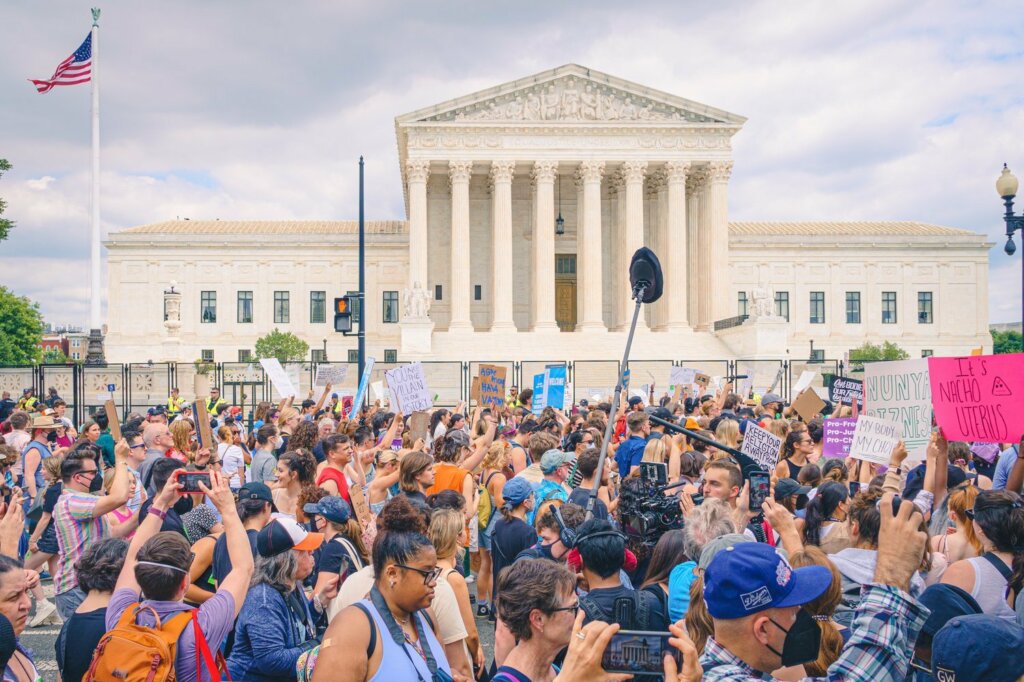
On Dec. 5, 2025, the Supreme Court agreed to hear Trump v. Barbara, a case that could determine the citizenship status of millions of Americans. President Trump made the end of birthright citizenship a priority of his administration even before his inauguration. But the administration’s attack on birthright citizenship isn’t just about immigration. It’s a bid to rewrite the rules of constitutional interpretation itself — and Republicans should fear winning this fight.
The 14th Amendment explicitly states, “All persons born or naturalized in the United States, and subject to the jurisdiction thereof, are citizens of the United States and of the State wherein they reside.” Upon his return to the Oval Office, President Trump signed Executive Order 14160, denying citizenship to children born in the United States to undocumented immigrants and temporary visa holders. The order has been enjoined in five lower court cases — Trump v. Washington, Trump v. Barbara, Trump v. New Jersey, New Hampshire Indonesian Community Support v. Donald J. Trump, and Trump v. CASA — prompting the administration to file a petition for certiorari before judgement, a rare maneuver requesting that the case bypass appellate review and land directly on the Supreme Court’s docket. The Court recently ruled in Trump v. CASA on the narrow procedural question of whether federal courts can issue universal injunctions, and has now granted certiorari in Trump v. Barbara to hear arguments on the merits of birthright citizenship itself.
For Trump and his allies, winning this case would certainly appear to be a victory. In reality, however, that win would dismantle a constitutional architecture that protects the rights many Republicans hold dear and fight most diligently for. The Supreme Court should — and seemingly will — reject the attempt to end birthright citizenship. However, the deeper reason for the decision would have little to do with immigration policy; rather, it would prioritize preventing a constitutional free-for-all where any administration could reinterpret explicit constitutional text to serve their political agenda.
Not all constitutional rights are as clear-cut as they seem, but birthright citizenship sits atop the hierarchy of clear textual protection. The 14th Amendment contains unambiguous language regarding citizenship. Interpreting this text does not require penumbral reasoning or the stitching together of an implied privacy right from decades of constitutional examinations, as was the case for landmark decisions such as Roe v. Wade and Griswold v. Connecticut. In stark contrast to the rights to abortion and the use of contraception affirmed in those cases, the assurance of birthright citizenship is grounded in explicit, declarative text that requires no interpretive gymnastics.
The protections established by Roe and Griswold are judicially created rights, vulnerable precisely because they lack textual armor. Indeed, just a few years ago — in Dobbs v. Jackson Women’s Health Organization — the Court rejected the federal right to abortion established through penumbral reasoning in Roe v. Wade. Birthright citizenship, however, is written in plain English, ratified explicitly to protect the right to citizenship for formerly enslaved Americans, and the drafters’ broad language was deliberate. In 1866, Senator Jacob Howard, who introduced the Amendment on the Senate floor and played a key role in its drafting, declared that the citizenship clause would include “[e]very person born within the limits of the United States,” with the exception of “foreigners, aliens, who belong to the families of ambassadors or foreign ministers.”
In United States v. Wong Kim Ark (1898), the Court offered further clarity, establishing that children born in the U.S to Chinese immigrants who were barred from naturalization still possessed birthright citizenship. The decision held that “the Fourteenth Amendment affirms the ancient and fundamental rule of citizenship by birth within the territory…including all children here born of resident aliens.” The Wong Kim Ark precedent has prevailed and remained unbroken through waves of immigration anxiety, world wars, and shifting political power. It represents one of the most settled areas of constitutional law.
Even so, in his Jan. 20 Executive Order, President Trump contends that “the Fourteenth Amendment has never been interpreted to extend citizenship universally to everyone born within the United States.” The order essentially extends the Wong Kim Ark exception — that “the children of foreign ambassadors or invading armies” are not “subject to the jurisdiction” of the United States and instead “remain subject to a foreign power” — to the children of undocumented immigrants. Brett Shumate, the lawyer who argued for the federal government, amplified this extension in federal district court, claiming undocumented immigrants or their American-born children “remain subject to a foreign power,” and therefore “have no allegiance to the United States.”
However, Shumate’s argument collapses under scrutiny: Jurisdiction and allegiance are distinct concepts, and the 14th Amendment speaks exclusively to the former. An unborn child cannot swear allegiance to any nation, cannot distinguish between America and any other foreign sovereignty, and cannot make political commitments of any kind. Yet that child and their parents are absolutely within the jurisdiction of the United States, subject to its laws, prosecutable in its courts, and protected by its Constitution.
As such, what Trump and his allies are actually arguing for is far more dangerous than a narrow reading of the Constitution. They are asserting that the 14th Amendment’s explicit language doesn’t mean what it says, that the executive branch can reinterpret clear constitutional provisions for the sake of policy motivations, and that political agendas override genuine textual constraints. This is, at its core, constitutional interpretation unmoored from text — precisely the judicial activism conservatives have spent decades condemning.
Once established, such a precedent becomes available to any administration pursuing any policy goal. No president or court can limit constitutional reinterpretation to partisan priorities or to narrowly tailored ideological outcomes. Once the tool is created, anyone can wield it.
Utilizing this same interpretative maneuver, a future Democratic administration could argue that the First Amendment is too permissive in the digital age and narrow what “speech” means or restrict what “press” protects to exclude online platforms. Furthermore, progressive reformers could justify campaign finance regulations by reinterpreting political spending as conduct rather than “speech,” unraveling decades of conservative First Amendment victories.
But the most perilous threat posed by a potential win on the birthright citizenship issue is the threat to the Second Amendment right to bear arms that many Trump supporters fight vigorously to protect, and that many liberals remain eager to restrict. The Second Amendment’s language is even more ambiguous than the Fourteenth, interpretable as granting the right to bear arms only to a “well regulated militia.” A future administration could easily argue that this language does not pertain to individual citizens, but rather only to organized and state-regulated militias. If conservatives succeed in reinterpreting the clear 14th Amendment text to exclude millions from citizenship, they risk forfeiting the ability to defend the ambiguous Second Amendment against a similarly aggressive reinterpretation.
If the Trump administration secures a win in ending birthright citizenship, Republicans will watch as their own trap snaps shut on them from behind, as the precedent set by their belligerent policy agenda is used to undermine a plethora of rights they hold dear.
The implications pose a serious problem for the justices who have built their jurisprudence on the foundational principle that the Constitution means what it says. Justice Neil Gorsuch’s opinion in Bostock v. Clayton County (2019) demonstrates deep textualist commitment even under politically inconvenient circumstances. Writing for the majority in a case concerning Title VII’s protection against discrimination on sexual orientation or gender identity grounds, Gorsuch held, “An employer who fires an individual for being homosexual or transgender fires that person for traits or actions it would not have questioned in members of a different sex.” The Bostock decision is just one example of the interpretive framework that Trump and his allies will dismantle in advocating for such a drastic reinterpretation of explicit constitutional text in the birthright citizenship case.
Moreover, overturning 127 years of Wong Kim Ark precedent would only invite accusations of obvious judicial activism and signal the Court’s willingness to contort constitutional meaning only to accommodate the executive’s agenda. For a court already facing historic lows in public confidence, such a decision would represent jurisprudential suicide.
The Trump administration is asking the court to remove the only lock on the proverbial constitutional safe to grab one item today, only to realize others can grab whatever they want tomorrow.
In an era when constitutional meaning faces constant political scrutiny, explicit text is the last and strongest line of defense. A Supreme Court that protects birthright citizenship preserves the principle that constitutional text matters, has meaning, and is immune to cheap political manipulations. Once the precedent of drastic constitutional reinterpretation is established, no right is safe. Not free speech. Not religious liberty. Not gun ownership. The very foundation of limited government is at risk of crumbling when clear constitutional language becomes negotiable. Republicans need to reframe what winning means before they destroy the textual firewall protecting textualist and originalist rights.
Conservatives should hope that the Court denies them this hollow victory, because the alternative isn’t just losing birthright citizenship — it’s losing the Constitution itself.