Oil is often called “black gold.” And rightly so — given our constant need for fuel, oil has immense economic value. As the world’s most common energy source, global crude oil demand averaged 102.7 million barrels per day in January. In the United States alone, the American Petroleum Institute estimates that 38.9 million Americans fill up their gas tanks every day.
Given just how valuable oil is to the global economy, it is no surprise that countries with vast amounts of oil hold significant geopolitical influence. But just as oil can bring wealth and prosperity to a nation, it can also bring poverty and crisis. The country of Venezuela is an unfortunate case of the latter.
Venezuela’s 2024 Presidential Election
Venezuela is a country plagued by an autocratic regime that has a chokehold on its people. The regime, led by President Nicolás Maduro, has been responsible for crushing media outlets, silencing critics, and committing human rights violations involving enforced disappearances and torture. This has all been part of a constant effort to crack down on criticism of the Venezuelan government and the Maduro administration, leaving ordinary Venezuelans helpless since Maduro’s ascension to power in 2013.
The economy under the administration is also suffering. Venezuela has a staggering poverty rate of over 80%, an inflation rate of 190%, and an economy that has shrunk by a historic 70% between 2014 and 2021. This has created a situation in which an overwhelming majority of Venezuela’s population lives paycheck to paycheck, working second and third jobs while only making $100 to $200 a month.
To make matters worse, Venezuelans are unlikely to feel relief anytime soon, as the 2024 presidential election between autocratic leader Nicolás Maduro and opposition candidate Edmundo González made abundantly clear.
Before the 2024 election, there was hope that the election in Venezuela would be free and fair. Over concerns of election interference and the pressure of economic sanctions imposed by the United States, the Maduro administration and Venezuela’s opposition party reached a deal termed the Barbados Agreement. The agreement required the Maduro administration to set an electoral calendar, lift bans on top opposition candidates running, and invite observers from the European Union to review Venezuela’s election process while it was underway.
Yet, despite their initial compliance, Maduro’s inner circle would begin to undermine the agreement as the election approached. They arrested opposition campaign staffers and human rights defenders, while revoking invitations to observers from the European Union. In addition, the government banned the leader of the opposition coalition Democratic Unity Roundtable (MUD), María Machado, from contesting the election, bought votes from the public under the guise of government-sponsored social programs, and continuously spread rhetoric instilling fear into ordinary Venezuelans, with Maduro even saying that there would be a “blood bath” if his party lost. While the U.S. would eventually reimpose oil sanctions on Venezuela for Maduro’s actions, the economic threat was not enough to force the administration into holding fair elections.
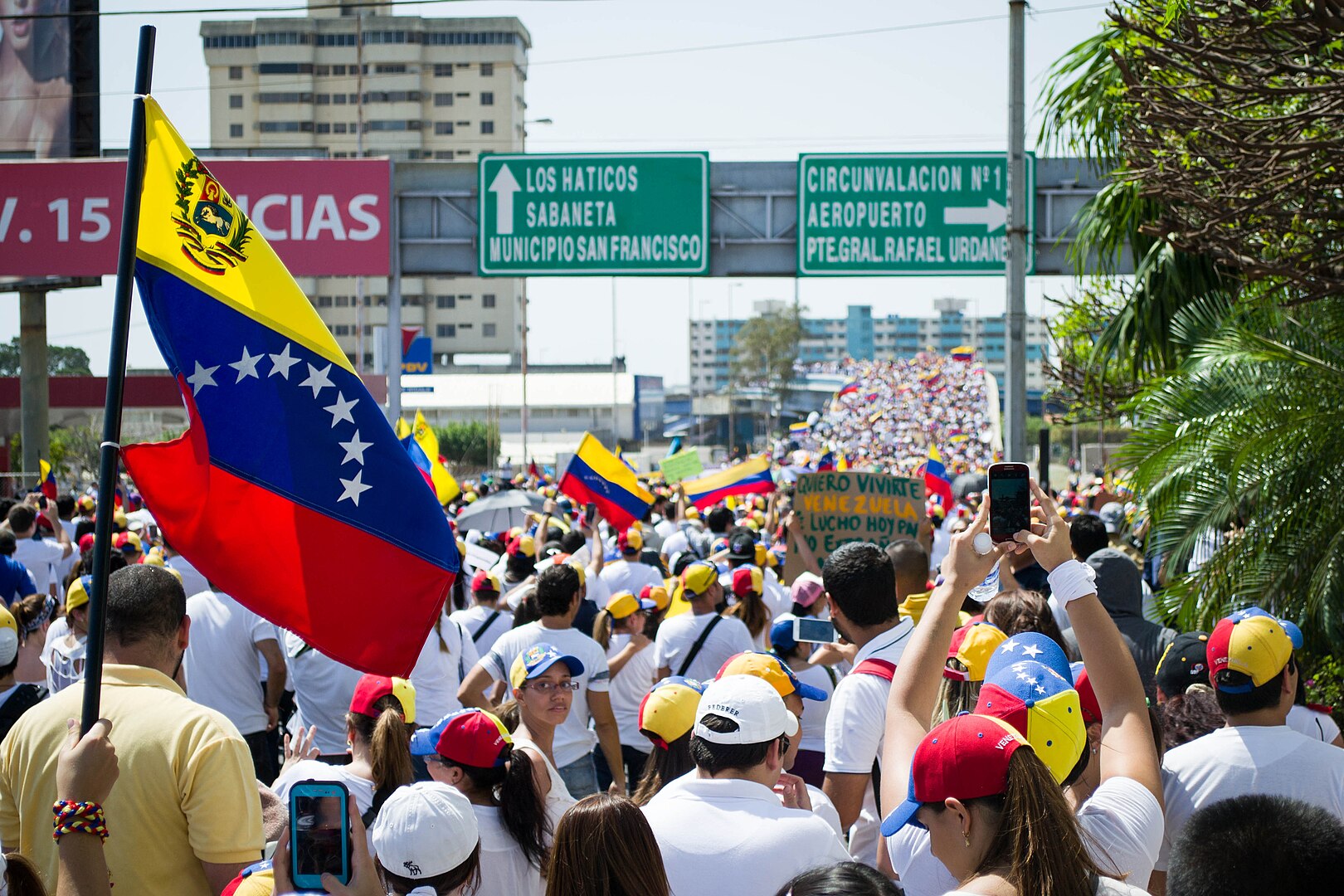
The result? Pre-election polls predicted that anywhere between 60% and 70% of the votes cast by Venezuelans would go to MUD. During the election, precinct-level tally sheets indicated that, with over 80% of the votes counted, MUD was leading by an overwhelming 67%. However, after the election, Venezuela’s National Electoral Commission (CNE), an agency effectively controlled by the Maduro administration, egregiously declared that Maduro won 51.2% of the vote, with only 43.2% going to MUD. No data from Venezuela’s 30,026 voting precincts was cited, representing a clear omission of the evidence required to certify the results of the presidential election. Foul play was immediately suspected, and thousands of Venezuelans took to the streets in protest, with authorities arresting over 2,400 people since the declaration of election results.
Unfortunately, this outcome is not surprising. The Maduro administration similarly used the military and the courts to hold onto power after the 2018 presidential election, when the opposition-controlled legislature decried the ban on top opposition candidates from running in the first place. In short, Venezuela’s political landscape has been plagued by a regime that refuses to give up power, going so far as to commit acts of violence against the Venezuelans who speak against it.
How Oil Ruined Venezuela
But how has this all happened, and what does oil have to do with it?
Oil was first discovered in Venezuela in the 1920s, leading to an impressive annual production of 137 million barrels per year, eventually accounting for over 90% of Venezuela’s exports. Originally, foreign drilling companies dominated Venezuela’s oil economy. However, in 1976, former President Carlos Andrés Perez nationalized the oil industry, creating the state-owned Petróleos de Venezuela, S.A. (PDVSA). PDVSA proceeded to dominate the oil sector, holding a 60% equity stake in joint ventures with profitable foreign drilling companies.
Venezuela’s dependence on oil seemed to work, benefiting from a period of consistently high oil prices. However, in the 1980s, global oil prices crashed as a result of increased oil supply at a time of global recession and reduced demand. In Venezuela, turmoil ensued. Running out of revenue, the government started printing currency, leading to skyrocketing inflation and soaring poverty within months. Outraged by the government’s failure to manage its resources, people took to the streets, with riots escalating across the country. Amid all the political unrest, one man united Venezuelans in the 1990s and set the stage for the country’s evolution into what it is today: Hugo Chávez.
Chávez was a military official who launched a failed coup against President Pérez in 1992 and was elected president in 1998 on a socialist platform. He campaigned on the promise to use Venezuela’s resources to expand welfare programs and bring people out of poverty. Indeed, Chávez initiated social welfare programs called “Bolivarian missions” to provide aid to Venezuelans, such as educational services and free health clinics.
However, he also used his popularity to institute an autocratic regime. Chávez replaced experienced PDVSA workers with people loyal to his administration, ended term limits, and shut down independent media outlets. Not only did these changes strip Venezuela of its democracy, but they left the country economically unprepared when oil prices took an additional dive in 2014, plunging the nation into a deeper crisis.
What Venezuela’s History Means Today
These events have led to the Venezuela we know today. After Chávez’s death in 2013, the suppression of free speech, removal of constitutional limits, and scrapping of checks and balances during the Chávez era have been inherited by Nicolás Maduro. This precedent has allowed Maduro and his administration to maintain their stranglehold on Venezuela. In other words, Venezuela’s dependence on oil led to the chaos that gave Hugo Chávez his popularity and his ability to alter the Venezuelan political landscape irrevocably. This chain of events makes Venezuela a key example of a petrostate, an oil-dependent state ravaged by corruption and the concentration of power.
How Venezuela will emerge from its crisis remains uncertain. What is certain, however, is that as millions innocuously fill up their gas tanks, the “black gold” that the world has come to value so much has led to the destruction of Venezuela’s democracy and the lives of the Venezuelan people.