

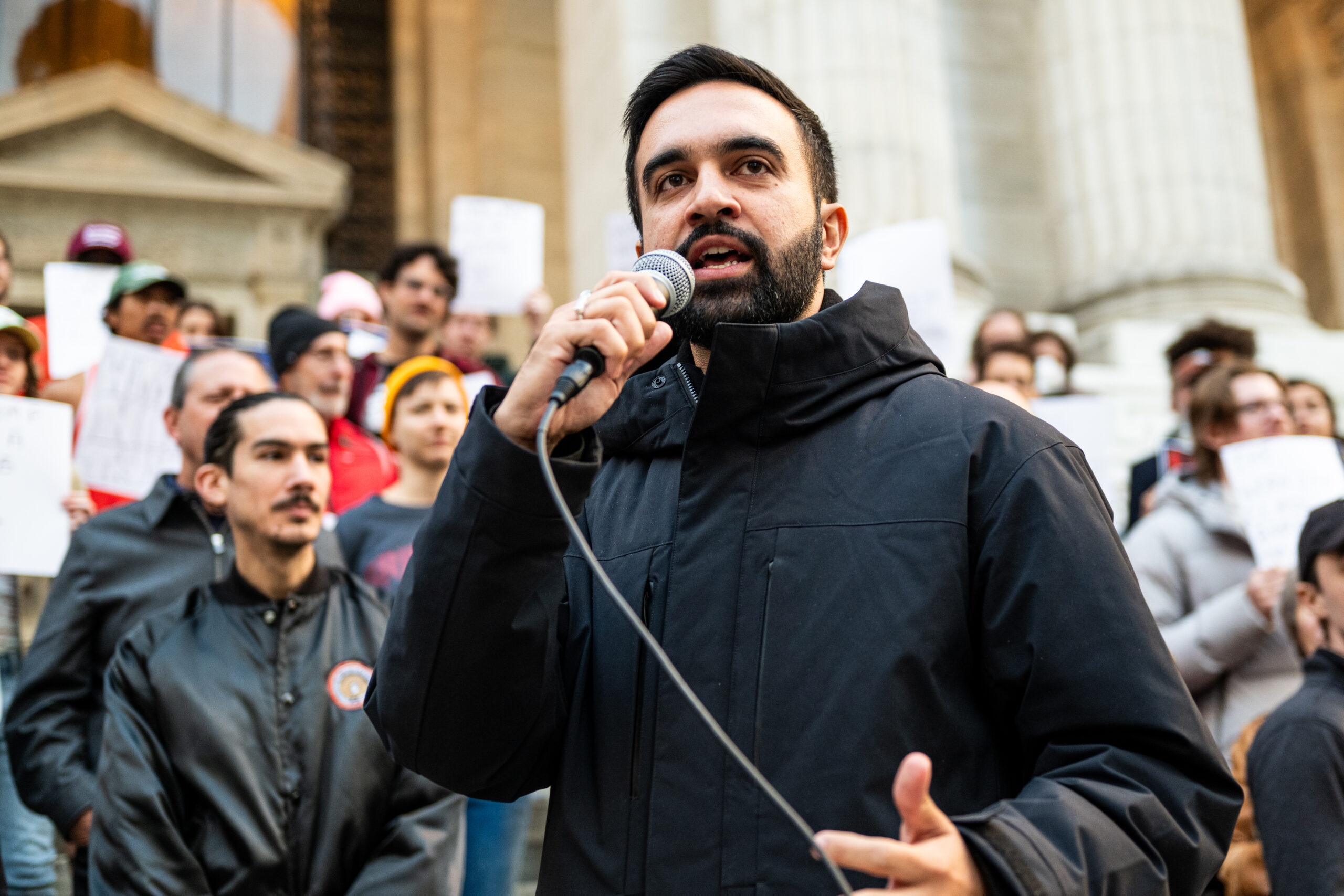
With Zohran Mamdani’s victory in the New York City Democratic primary, it is clear that democratic socialism is on the rise. Many younger Americans, especially in left-leaning cities, are turning away from establishment Democrats and towards the progressive promises of government-run grocery stores and rent freezes. These policies are flagship platforms for modern democratic socialism and are turning the heads of established party members. While proponents of these policies, such as Vermont Senator Bernie Sanders, have been around for decades, America was not listening. So what has changed?
To begin understanding this phenomenon in the U.S., one must first look to the differing definitions that have catapulted socialism back into the American lexicon. Right-leaning sources depict socialism similarly to conservatives of yesteryear: a policy that “doesn’t level the playing field — it levels the entire country into shared misery.” On the other hand, left-leaning outlets have spun socialism as a utopian alternative to a society that “[turns] human suffering into profit, while convincing the world it’s progress.”
The truth of socialism is somewhere in between these depictions. Megan Day, Jacobin editor and author of “Bigger than Bernie: How We Go from the Sanders Campaign to Democratic Socialism,” described socialism as “an economic system in which production is organized along lines of […] common need rather than private profit.” Even through the confusing narratives that have swayed American opinions on socialism for the last century, Day is convinced “that’s what it meant in 1850, that’s what it meant in 1910, that’s what it meant in 1950, and that’s what it means today.”
American Socialism’s Roots
Since the beginning of the Industrial Revolution, socialism has been a taboo subject, seen as the “enemy of progress” by American politicians and the populace alike. This collective fear was only heightened during the Cold War when the Soviet Union blurred the lines between socialism and even less popular economic philosophies like communism and fascism.
During the era of post-WWII McCarthyism, being labeled as a socialist was akin to social and professional suicide, yet stigma against the economic ideology remained even after McCarthy’s downfall. During the late 1940s and early 1950s, 39 states required public employees to take loyalty oaths, effectively preventing those with socialist ideas from public service jobs. Libraries even removed books that were deemed too leftist, including classics like “Robin Hood” and “The Grapes of Wrath.” Ralph Brown, a Yale Law School professor at the time, conducted the largest systematic survey investigating the number of jobs lost due to political affiliations and found that over 10,000 individuals were blacklisted due to leftist affiliations.
Throughout the next half-century, American opinions on socialism remained relatively stagnant. Even during the rise of the New Left — a widespread 20th century movement that protested cultural issues — and the collapse of the Soviet Union, the majority of Americans frowned upon the socialist economic system.
After the Great Recession in 2008, which left many Americans unemployed, homeless, and financially devastated, lots of Americans benefited from existing socialist policies, such as social security and unemployment insurance. Many benefactors of these programs, especially younger Americans, began to question capitalism as a whole because it riddled the country with income inequality. Bhaskar Sunkara, founder of The Jacobin and author of “The Socialist Manifesto,” when asked about this generation’s open mindset to socialism, told the HPR that “many of us who are younger grew up in a world without the Soviet Union and without the Eastern Bloc and that has reduced some of the stigma around the word socialism.”
The next decade was characterized by one of the most powerful Democratic presidencies in recent history. Barack Obama’s liberal policies — such as Deferred Action for Childhood Arrivals and same-sex marriage legalization — primed America to be receptive and open-minded when it came to progressive ideologies. Bernie Sanders capitalized on this when he ran for president in 2016. While he had been serving in politics since 1981, his presidential campaign brought his name to the national stage when he won 46% of the Democratic primary votes and came in second to former Secretary of State Hillary Clinton.
While Sanders’ presidential campaign was ultimately unsuccessful, he was still able to create an environment for openly socialist politicians to thrive in the Democratic Party. Just two years after Sanders’ initial breakthrough, four progressive women of color — Alexandria Ocasio-Cortez, Ilhan Omar, Ayanna Pressley, and Rashida Tlaib — were elected to Congress and soon after became known as the original members of “The Squad.” They coined this term themselves in an Instagram post shortly after the election to signify their commitment to supporting progressive ideals and voting together. All four of these original progressive Democrats still serve in the House, along with new progressive additions like Summer Lee and Greg Casar, who have joined their cause. Their successful campaigns suggest that America’s voting population is willing to support more and more left-leaning ideologies within the Democratic Party.
Today’s Stage
America is an election away from having its biggest city, with over eight million residents across all ages, ethnic backgrounds, and socioeconomic situations, overseen by an openly socialist mayor. People across the country, especially older Americans on both sides of the aisle, were stunned by Mamdani’s nearly 19-point landslide victory over former Governor Andrew Cuomo in June. While the final outcome of the New York City mayoral race will be determined on Nov. 4, Mamdani’s primary victory alone represents a reckoning: socialism can survive in the ring against the other popular ideologies.
While New York, a liberal city, should not be viewed as a microcosm of America as a whole, recent polling suggests broader trends toward acceptance of socialism taking place at a national scale. A 2022 Pew Research Center poll found that 40% of Americans aged 18–29 view capitalism positively, while 44% have a favorable view of socialism. A recent Cato and YouGov survey also shows that 62% Americans aged 18-29 expressed favorable views of socialism, and 34% viewed communism favorably as well.
The stage seems to be set for a political renaissance for American socialism; when asked about the biggest opportunity for the socialist movement, Duke History and Public Policy Professor Dr. Nancy MacLean told the HPR that a Mamdani victory would be “a huge opportunity, you know, to show what that kind of progressive governance would look like.”
Even with numbers to back up the claim that socialism is on the rise, many Americans are still confused as to how this shift took place, considering that eighty years ago, being labeled a socialist would have cost any American their job, their friends, and even their freedom. Megan Day points out that “the rising cost of living and the outlandish shamelessness of the American ruling economic elite are combining into one mega opportunity for socialists to make their case.”
In an interview with the HPR, Day emphasized how astounding the inequality is between “tomato farmers in California” and multi-billionaires like Jeff Bezos. Day notes how apparent the staggering inequality is to everyday citizens and how the working class is willing to push back against it, explaining“people are pissed off and and and the shamelessness of the American ruling elite has been so profound that nearly everyone can see with their naked eye that this system is rigged against average people.”
While inequality is at its highest in American history, it is also at its most visible. With social media more prevalent than ever before, people can now see into each other’s lives with an unprecedented level of access. Factory owners may have flaunted their wealth during the Industrial Revolution, but in the 2020s, anyone can flaunt what they have.
Moving Forward
Perhaps Mamdani is a flash in the pan; Andrew Cuomo was scandal-ridden and blemished. But on the other hand, AOC and Sanders are holding rallies across the country with unbelievable turnout and passion. As far as American socialism is concerned, the question remains unanswered: Is this a blip? Or a trend? Or a movement?
Only time will tell. Incumbent Eric Adams has recently dropped out, leaving just Andrew Cuomo in the running. Now the question remains, will Mandani win the election, and if so, can he create the change that democratic socialism promises?

Associate U.S. Editor