

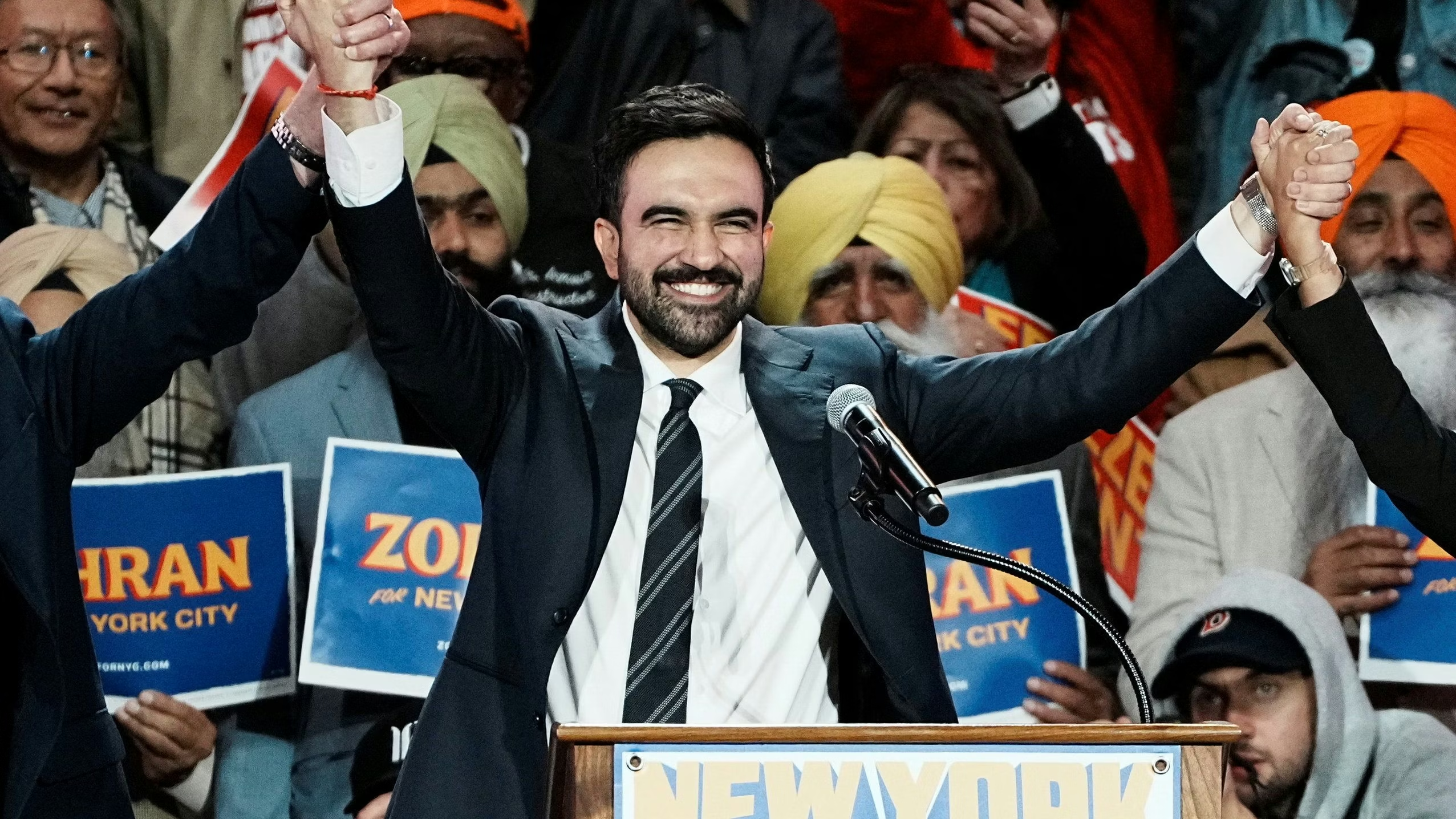
In one of the most surprising political storylines of 2025, former New York state representative Zohran Mamdani overtook former Governor Andrew Cuomo to win the New York City mayoral election. Following the withdrawal of incumbent Eric Adams, Mamdani — a naturalized American citizen of Indian and African descent with a progressive democratic socialist agenda — captured the hearts of over half a million New Yorkers in July’s mayoral primaries and sealed his victory on Nov. 4, winning 50.8% of the vote. With a charismatic, voter-oriented rhetoric rarely seen in the American left today, he is already being regarded by some as the face of a Democratic Party currently lacking an overarching identity.
While certainly newsworthy, Mamdani’s election victory did not occur in a vacuum. Over the past several years, the Democratic Party has seen itself shift leftward in an effort to counter Trump’s fiery populist appeal to the right with equal intensity. The rise of Kamala Harris, whose voting record in the Senate was rated one of the most liberal, to her terms as Vice President in 2020 and Democratic candidate for president in 2024, is a case in point. Despite her success within the party, major left-leaning PACs and political commentators have decried the party’s waning attention to issues of traditionally greater importance, such as economic incentives for middle-class Americans.
Indeed, a return to the traditional political center is imperative for the Democrats to retain relevance and combat counterproductive polarization in today’s landscape. As such, Mamdani’s election victory — fueled by a polarizing policy platform and incendiary name-calling — may prove detrimental. According to recent polling, 70% of Americans are dissatisfied with the Democratic Party’s priorities, at a time when the party faces significant alienation from once-faithful voters nationwide. Today, the nation should focus on building bridges and finding ways to cross the aisle in a time of extreme polarization, not on reinforcing partisan echo chambers that divide voters and weaken our democracy.
A Dangerous Backdrop of Polarization
To be clear, Mamdani himself isn’t the problem. He’s a strong, charismatic leader exemplifying the hopeful approach to politics the nation yearns for. Although I fear his policies — such as instituting rent freezes, subsidizing bus fares, and encouraging more protesting — may be ineffective, I am more concerned about the growing split his election can produce in a polarized country. Leading a hardline progressive agenda amidst the current political climate is dangerous not only for the national Democratic Party, but also for the nation as a whole. We’ve seen countless times what happens when overwhelming partisanship — and, in turn, a rejection of aisle-crossing policy and sentiments — reaches a climax, whether it’s the overreach and subsequent failure of McCarthyism, the immense backlash against Newt Gingrich’s “culture war” Congress, or, more recently, the Jan. 6, 2021 Capitol insurrection. When it comes to both policy and rhetoric, negative partisanship and “us-versus-them” politics inhibit the country from forming “a more perfect Union,” even when the shortcomings of “them” seem unforgivable and the ideals of “us” seem promising.
In the U.S., the hardline agenda has proven to backfire, as platforms explicitly demonstrating negative partisanship have galvanized and further polarized bases. For instance, Trump’s MAGA supporters continue to respond with staunch antagonism to the Democratic ticket thanks to actions like vice-presidential candidate Gov. Tim Walz, D-Minn., calling Republicans “weird.” In the same vein, President Trump set the Heritage Foundation’s ultra-conservative Project 2025 into action, despite Harris’s many pleas for voters to reject it. Political polarization among Americans on both sides of the aisle has dramatically increased over the past several decades, at the same time as a marked decline in people’s trust in the nation. Division is not only a failing strategy for campaigns, but also a failing strategy for our country.
The increased openness among Americans to participate in childish, ad hominem attacks on political figures of opposing ideologies is a likely factor for this decline in trust. Although the media may exaggerate its effects, analyzing rhetoric is a helpful microcosm of this normalized hostility. Both nicknames, like “Sleepy Joe” and “Tampon Tim,” and comments, like former President Biden’s “Neanderthal thinking” remark, contribute to polarization. To counter the hateful memes, racist language, and weaponization of democratic institutions by Trump and his cabinet, Democrats must take the high road to bring the country back to a moral center — not engage in unproductive, performative crossfire such as calling Trump a “fascist” and “despot.” Fighting fire with fire is simply an ideological civil war. We must rely on compromise and concession to forge a productive path forward — and Mamdani’s progressive wing of the Democratic Party doesn’t publicly embrace such action.
At the end of the day, so much of modern-day politics revolves around optics. The rhetoric of political leaders influences, and is in turn influenced by, the tendency of politicians toward ideological compromise or division. As soon as the American right views Democrats as endorsing irresponsibly divisive behavior, the door is further opened to a hostile retaliation from the right. Seventy-four percent of Americans believe compromise is more important than having unflinching opinions, but only 9% have confidence that parties can work together in the current political climate. As charismatic as its face may be, a Democratic Party synonymous with Mamdani’s hardline progressive agenda and its accompanying rhetoric will only pick at the scab that is our political disunity.
Returning to the Political Center
Much of Mamdani’s proposed legislation introduces democratic socialist measures to make the city more affordable, such as universal childcare, public grocery stores, rent freezes, and free buses. In theory, these changes are a boon from the heavens for a city struggling with a housing crisis. But we’re talking about New York.
The New York Times calculated that the yearly cost of these measures would total a pre-boondoggle sum of $7 billion, exceeding the cost of the entire police force. Mamdani’s suggested fundraising methods, such as raising taxes on businesses and high-income residents, are subject to significant legislative and bureaucratic hurdles that could potentially drive these stakeholders away from the city.
Does freezing rent for over a million apartments truly address the housing crisis, or does it contribute to greater income inequality due to a lower supply of market-rate units? Does subsidizing bus fares truly speed up bus routes, or does it undermine efforts to collect millions in lost fares and provide necessary upkeep? Virtually every New York mayor has succumbed to the obstacles inherent in implementing ambitious measures in a city so difficult to change. It would be an awful look for the Democrats’ new poster child if Mamdani’s progressive action falls flat on its face.
Cuomo’s mayoral platform, which was fairly unambitious, would have been a better strategy to hold off criticism from the right until the emergence of a calmer political climate more conducive to progressive reform. For now, in the name of national unity, Mamdani and Democrats writ large should seek a future defined more by building bridges, and less by instituting policies that are already sparking right-wing criticism and hostility. Mamdani’s cordial Nov. 21 meeting with President Trump is an optimistic sign.
During polarized times, political moderates have found success time and time again. In my home country of Canada, I proudly voted for Mark Carney’s Liberal Party, whose fiscally pragmatic and socially liberal platform successfully reconciled the polarizing platforms of Conservative Party leader Pierre Poilievre and former Liberal prime minister Justin Trudeau. Indeed, Carney’s first order of business after attaining the top job last March was to scrap the highly controversial consumer carbon tax, a main component of Poilievre’s own campaign. Carney’s victory proved that centrist, conciliatory leaders can win federal elections; the Liberals had been down in the polls by as many as 27 points just a few months prior to Election Day under Trudeau’s deeply unpopular leadership. If that case translates to the American political sphere, Democrats could have prevented the possibility of being blanketed nationally under Mamdani’s polarizing leftism had a more cooperative figure won the New York election.
As political commentator Ezra Klein notes, while the Democratic Party would benefit from an agenda oriented around economic populism, the diversity of American viewpoints cannot be sufficiently captured by any singular party ideology. The party doesn’t have to shift to the right, but Democratic platforms should consider reconciling with center-right ideologies — at least temporarily — in order to better represent the opinions of the country while bringing us to a place of reduced polarization. A proper response to the political climate comes hand in hand with achievable policy, perhaps the facet of Mamdani’s administration least likely to succeed.
Despite the aforementioned pitfalls of Mamdani’s platform, salient left-wing counter-arguments can be made in the name of strong progressive action. Historically, Democrats have been the most successful when they champion social movements: President Roosevelt’s ambitious New Deal contributed to Democratic majorities in the House and Senate following Depression-era doldrums, and support for the Civil Rights Movement in the 1960s laid the foundation for a new progressive agenda. Under President Obama, the candidate perhaps most similar to Mamdani in terms of charisma, the implementation of Obamacare and signing of the Paris Accord undid the largely center-right politics of Presidents Clinton and Bush while providing Americans with a clear vision for the future.
Today, however, our political landscape offers far less potential for a unifying coalition around progressive ideals. As we’re more polarized than ever, we need unifying compromise, not radical change. The left needs a leader of its own whose outreach and rhetoric outdoes his or her potential for polarization. In order to prevent a Clinton-like alienation of middle-class concerns, Democrats should seek to bolster the middle class with a focus on affordability — albeit with more moderate policies than Mamdani’s, which are bound to fail in practice. Only after retrieving a long-lost spirit of collaboration can the country be poised to rally behind more ambitious platforms.
In any case, the recent New York mayoral election is a microcosm for the future of American politics. As Mamdani gains prominence among Democrats nationwide, the U.S. runs the risk of further division as Americans conflate hardline progressive ideologies with moderate centrist reforms in the Democratic Party. For the health of the country, polarization must be quelled by any means necessary. A return to unambitious centrism through concession and compromise can orient our country to a more unified and civil foundation for the future.

Associate U.S. Editor