

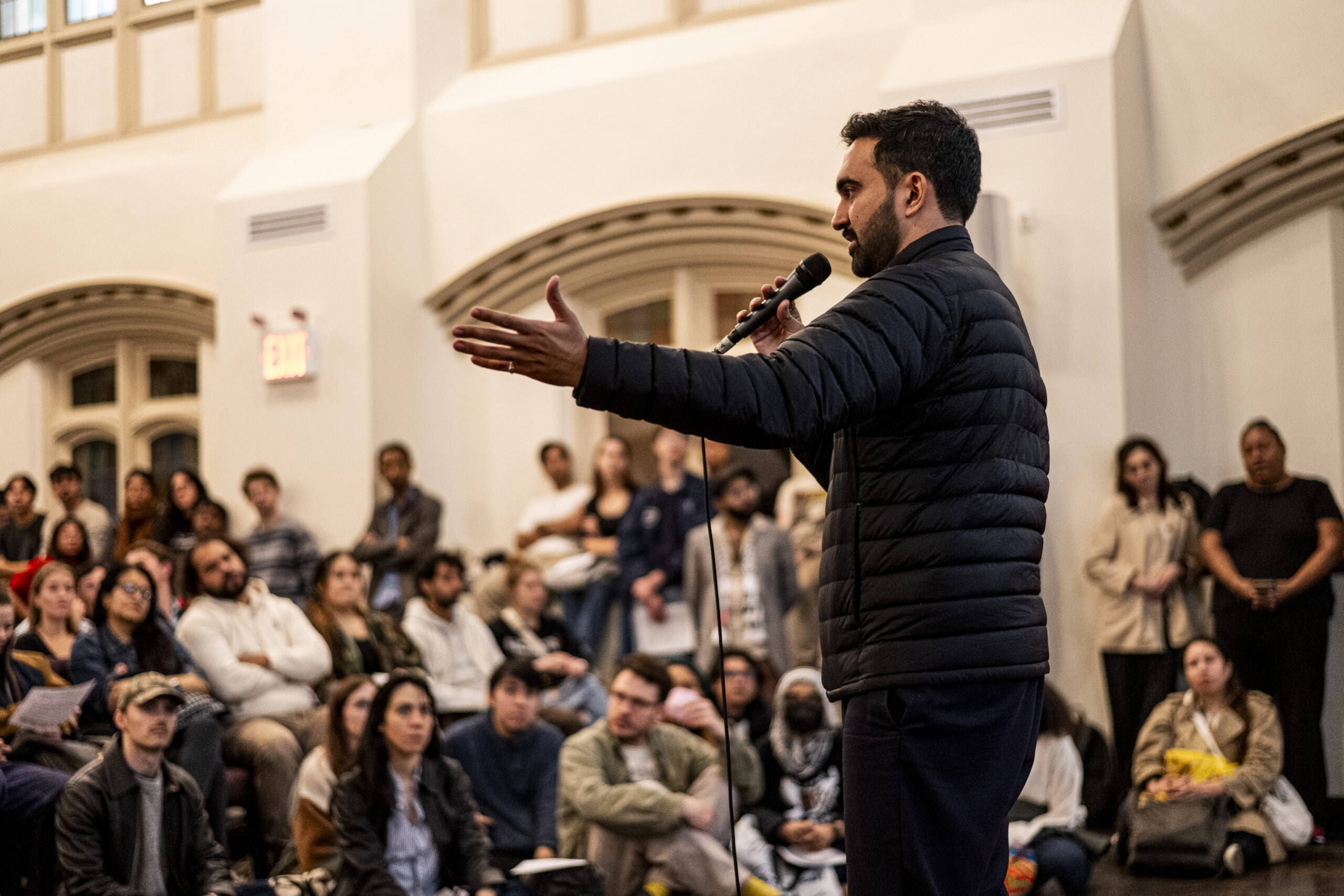
In 2020, Zohran Mamdani won his first election for New York State Assembly District 36 by under 500 votes, a mere 2.6% margin. Only five years later, in October 2024, Mamdani announced his candidacy for mayor of New York City. Unsurprisingly, after five months of campaigning, per Emerson College, the assemblyman only had 1% of the first-choice vote in the Democratic primary.
Yet, in just seven months, Mamdani’s popularity exploded, transforming the New York City mayoral election and challenging the supposed shoe-in ex-governor, Andrew Cuomo. On June 24, in just less than 12 hours of open polls, Mamdani beat Cuomo in the primaries, securing a comfortable lead and forcing Cuomo to concede. After ranked choice voting, Mamdani won 56.2% of the votes for the Democratic party nomination.
Less than a month after this loss, however, Cuomo entered the mayoral race again as an independent. Later, the incumbent mayor, Eric Adams, who won in 2021 as a Democrat and ran this year as an independent, dropped out of the race. This left Mamdani facing Cuomo again in the general election, as well as Republican candidate Curtis Silwa. And after polling considerably ahead, contrary to his first victory, Mamdani would surprise no one and be elected Mayor of New York City.
This raises a fundamental question: at a moment when Democrats are facing historic lows in popularity, how did Mamdani redefine what it meant to run for office as a Democrat? And even if critics argue his platform is not applicable or popular at a national level, how did Mamdani mobilize so many people?
An Economic, not Democratic, Focus
A little over a week after Trump’s victory in 2024, Mamdani, a New York State Assembly member for a city that shifted toward Trump in the most recent election, went to the streets of his district and asked the simple question: Why did you vote for Trump?
Again and again, the answer was affordability. Even for voters who disagreed with much of Trump’s platform, they believed his campaign was most likely to address the economic pressure they felt daily. Mamdani came to the conclusion that his campaign needed to have a vigorous and explicitly economic focus, moving his “political instinct from lecturing to listening.”
He launched a campaign centered on affordability, and as a member of the Democratic Socialists of America since 2017, he settled on policies aligning with his ideological leanings. Including rent freezes, free childcare, free buses, and even a pilot program of state grocery stores, his initiatives promised radical change funded by a controlled hike in taxes to the wealthiest New Yorkers. As his campaign caught momentum, his slogans like “Freeze the Rent,” “Lower Groceries,” and “Childcare For All” made headway, branding him as an economic-focused candidate.
In the context of the national Democratic Party, however, it seems difficult to recreate Mamdani’s strategy, especially on policies that even some Democrats have been resistant to. Over the last few decades, Democrats have operated within the “mobilize or swing” dilemma: whether to mobilize new left-leaning voters by moving further left, or remain in the center to attract undecided and moderate voters. And for the most part, Democrats chose to do the latter, as evidenced by Former President Biden and Vice President Harris’s stances on immigration and other policies.
In this reflection on where to specifically stand on the political line, however, the Democratic Party has been chained to internal partisanship, rather than looking for creative and dynamic ways to mobilize voters. Mamdani not only mobilized voters through a more left-leaning agenda but also by focusing his campaign on economic issues that attract voters from different political alignments, a strategy that fueled the Trump campaign.
In 2024, Brighton Beach, a neighborhood in Brooklyn, went to Trump by 44 percentage points, but Mamdani won by 16. College Point, a neighborhood in Queens, went to Trump by 11 points, but Mamdani won by eight points. Evidently, much of this is due to Republican voters who did not vote in the Democratic primary. But some of these voters were Trump-Mamdani voters because they voted for an economic-focused candidate, and the motives behind this group reveal strength in a campaign that leans heavily on an economic focus.
There is a problem with the mobilization versus swing argument: Democrats assume every voter is stubbornly stuck to a point on the political line. The majority of people, however, are not cemented into a particular position within the party; most of them can move, especially during turbulent times. People, surprisingly, can change their minds or try something new when things aren’t working.
So after Mamdani listened to his constituents, he brought a laser-focused campaign on economic issues to voters as a Democrat, rather than expecting voters to resign to vote for the Democratic establishment. As he explained, he gave voters “something to vote for, rather than something to vote against.” And that something was purely, and critically, economic.
Even if he was perceived to be a more radical and controversial candidate, much like Trump, ironically, people chose to side with his economic plan.
Kamala Harris, on the other hand, was unable to do this. Even if Trump spewed hateful misogyny and collected a history of controversy, he talked about the economy and framed unforgettable, economic-focused agenda items like “no tax on tips.” Polling in October 2024 showed that voters viewed Trump as a better fit than Harris to handle the economy, 54% to 45%. Thinking of the Harris campaign, it is troublesome to dig for a similar slogan that shows she cares about voters’ pockets. This was also the case for Cuomo, showing a throughline of both campaigns that points to a strong correlation between a lack of economic appeal and an unsuccessful election bid.
Ezra Klein’s Theory of Attention
Cuomo’s loss in the primary came as a shock due to many reasons, one being funding. Fix the City, a Super PAC run by advisers of Cuomo, became the largest Super PAC in the NYC Mayoral Race this year, raising over $25 million on top of $5.5 million spent by his campaign. On the contrary, Mamdani ran largely through small donors, spending a total of $6 million on his campaign and receiving significantly less support from independent committees. He even asked people to stop donating after reaching his maximum. In the end, Cuomo and his supporters spent over $87 per vote, while Mamdani and his supporters spent below $19 per vote.
Per these figures, Cuomo should have won the primary, especially considering his wide name recognition even prior to the election. However, as Ezra Klein, a New York Times Columnist, described, Cuomo only bought attention. Mamdani, rather, ran on a theory of viral attention: the act of gaining popularity through viral social media fame rather than traditional bought time on advertisements.
To begin his campaign, Cuomo launched a standstill, 17-minute video, lecturing New Yorkers on why he would be the best candidate. Oppositely, Mamdani launched almost daily short viral videos — whether of him creating the term “halal inflation” or joking on the social media show “Subway Takes.”
Mamdani won the viral world, and he did so without paying for advertisements, taking advantage of social media algorithms to boost his screen presence at minimal cost. Moreover, when he stood on the debate stage, he made sure to give viral, clip-worthy lines that would live in people’s heads far longer. For example, even when faced with his most controversial issue, his stance on Israel, he stood out as the only candidate saying he would stay in New York City, rather than travel abroad for a visit.
There is also something distinct about Mamdani’s virality, particularly when compared to the Harris campaign, which also achieved notable virality. Per Chris Hayes, Democrats lost voters who only get news on their phones by 15 points in the 2024 Presidential election. And this loss, despite the viral campaign, is perfectly explained by the most critical part of the theory of attention: bringing someone from the screen to the poll.
A podcast of Joe Rogan lauding Trump for his ideas to bring prices down by deporting immigrants makes voters believe their lives would be fixed by voting for Trump, regardless of whether what is said is true. It evokes real emotion by tracking the pains in life to a political candidate who cares about such issues. Although it might make a voter more interested in her campaign, a funny edit of Kamala Harris does not address an issue in voters’ lives, and therefore, it does not bring them to the polls.
In essence, virality is only effective if your popularity evokes a motivation to vote.
Moreover, the virality of these videos within Democratic factions that were already going to vote for Harris gives the illusion that people are being engaged with the campaign. However, regardless of how many people from different political backgrounds watched her content, her virality only made Democratic voters feel that their choice had a fun, silly side, and undecided voters feel that Democrats only had a fun, silly side to offer.
Mamdani, although witty and funny, focused his video on direct issues facing New York City, and gained not only online traction but votes in the polls, especially from new voters. As Rich Azzopardi, a spokesman for the Cuomo campaign, said in an interview with the New York Times, “Mr. Mamdani ran a campaign that managed to expand the electorate in such a way that no turnout model or poll was able to capture, while the rest of the field collapsed.”
Lastly, he followed up on that attention on the ground. He got people to build a movement, building a visible physical virality, as volunteers ran around New York with a “Zetro Card” which let them keep track of how many times they canvassed. Knocking on one million doors not only framed him as a fellow New Yorker, but fellow New Yorkers were asking you to help him out.
2026 and 2028
Frankly, there are several key differences between a national and municipal election. However, Mamdani offers many lessons about one thing Democrats massively misunderstood: voters.
While Harris disillusioned voters through an ineffective online strategy, Mamdani won over New Yorkers by focusing on the economic issues they deeply cared about, leveraging his trustworthiness on television and through volunteers at their door. He mobilized an entire voting block as the younger, less experienced candidate, even while opponents criticized his ideas as idealistic and radical.
Looking ahead to 2026 and 2028, it is clear that Mamdani isn’t the only one paving a strong Democratic image through theories of attention. Notably, Gavin Newsom has developed a similar witty and viral social media presence, as he and his team take stabs at Trump’s policies, which some argue could set Newsom up for a 2028 presidential run. Like Mamdani, Newsom and his team have been unafraid to post memes and entertaining videos condemning Trump. By naturally generating virality, he can connect with an increasing number of voters departing from Trump due to his more controversial actions like the Big Beautiful Bill, oscillating and uncertain tariffs, and deployment of the National Guard.
Pete Buttigieg, another possible presidential candidate for 2028, has also mirrored Mamdani’s use of virality by appearing on various viral podcasts — even some that endorsed Trump — in attempts to connect to voters with his notable oratory skills and voice of reason — hoping to create virality as a calm and reasonable presence in comparison to Trump’s often chaotic antics.
James Talarico, a Texas State Representative, has also exploded recently as he, through his social media posts, emerged as a leader in the fight against gerrymandering, even joining Joe Rogan to talk about his potential Senate run to turn Texas blue. Talarico has been viral on social media since before the most recent redistricting scandal, gathering a strong community of Texas Democrats and progressives, often led by Texan and Christian values, something of great appeal for the representative. Like Mamdani used an economic focus, his common-sense religious focus has allowed him to gain ground in Texas as a Democrat, with him recently announcing his senate campaign.
Mamdani, like these three figures, exhibited a lesson of both an economic focus and a theory of virality that has evidently proved effective. Regardless of how much people questioned his views and the practicality of his policies, he ran a modern, winning campaign. So, as Democrats turn to the future and look to win elections as a new party, it is time for them to take a page out of Mamdani’s playbook.

Senior Local Editor